Announcing the Agentic Catalog Experience in Amazon Q Developer: Transforming Enterprise Data Discovery
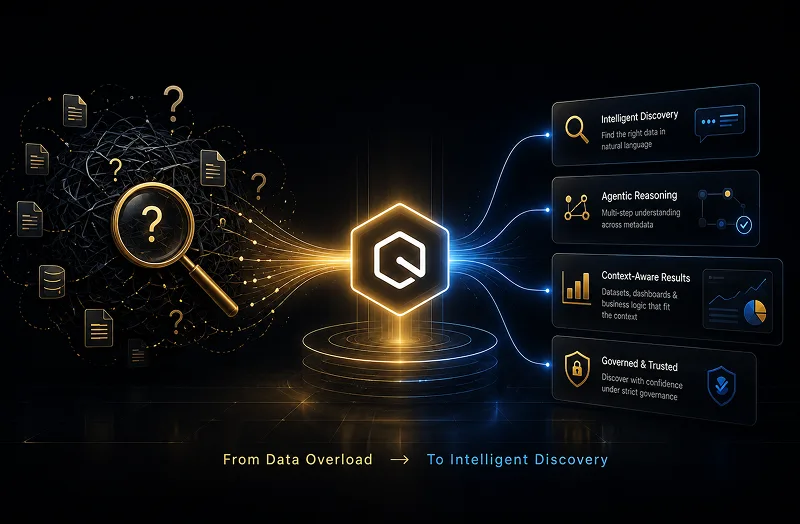
In large enterprises, finding the exact dataset, dashboard, or business logic required to answer a strategic question often feels like searching for a needle in a digital haystack. Even with centralized data lakes and business intelligence tools, teams lose countless hours trying to map technical schemas to actual business context. Today, we are thrilled to share details announcing the Agentic Catalog Experience in Amazon Q Developer, a major evolution in how technical teams and business decision-makers interact with enterprise data catalogs.
By fusing multi-step agentic reasoning with intelligent metadata indexing, this milestone feature turns passive data repositories into interactive, context-aware discovery engines. Below, we examine how this new capability works, how it solves common data friction points, and how organizations can leverage it to accelerate decision-making while maintaining strict governance.
The Data Catalog Bottleneck: Why Traditional Search Falls Short
For years, enterprise data discovery relied heavily on keyword-based searches or manual catalog tagging. While functional on a small scale, this traditional approach creates operational friction as data volumes grow:
- Semantic Misalignment: A financial analyst searching for "Q3 churn rates" might miss the relevant dataset if it is logged as cust_attrition_v3_final in a data warehouse.
- Siloed Metadata Context: Understanding a metric often requires jumping between data dictionaries, lineage charts, and BI dashboards.
- Orphaned Assets: High-value reporting assets often go underutilized simply because users do not know the exact schema names or storage locations.
How the Agentic Catalog Experience Works
Rather than simply matching characters in a query string, the agentic catalog framework uses autonomous, multi-step planning to decipher what users are actually trying to achieve.
Intent Decomposition and Multi-Step Search
When a user submits a natural-language query, the agent breaks the request down into logical sub-tasks. It searches across technical metadata, business glossaries, and lineage pathways simultaneously, evaluating candidate assets against the user's specific role and operational context.
Automated Context Enrichment
Instead of requiring manual tagging for every column and table, the agentic engine automatically evaluates relationships across datasets. It synthesizes schema definitions, recent usage patterns, and upstream dependencies to present a holistic, human-readable summary of relevant data.
Realizing Business Impact: From Raw Assets to Actionable Insights
Bringing an agentic catalog into daily workflows yields immediate operational efficiency gains across both technical and business functions.
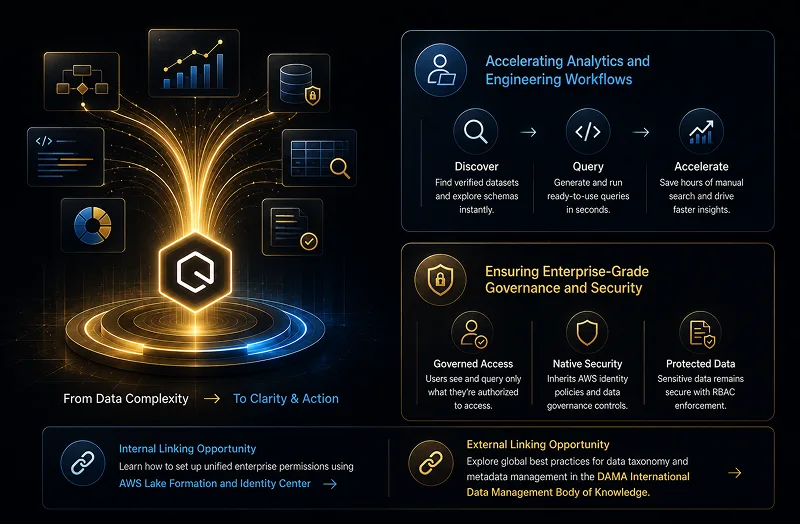
Accelerating Analytics and Engineering Workflows
Data engineers and BI authors no longer need to spend hours deciphering legacy database schemas or asking colleagues where specific staging tables live. By querying Amazon Q Developer directly within their environment, engineers can instantly pinpoint verified datasets, inspect column definitions, and generate ready-to-run queries.
Ensuring Enterprise-Grade Governance and Security
Speed means nothing without control. The Agentic Catalog Experience inherits native AWS identity policies and data governance controls. Users only discover and query assets that match their existing Role-Based Access Control (RBAC) boundaries, ensuring sensitive data remains fully protected.
- Internal Linking Opportunity: Learn how to set up unified enterprise permissions using [AWS Lake Formation and Identity Center] to enforce fine-grained access across AI services.
- External Linking Opportunity: Explore global best practices for data taxonomy and metadata management in the [DAMA International Data Management Body of Knowledge].
Key Takeaways
- From Passive Directories to Active Discovery: The Agentic Catalog Experience replaces static keyword searches with multi-step reasoning to match business intent with the right data assets.
- Reduced Analytical Overhead: Technical and business users spend less time tracking down schemas and data lineage, significantly shortening project timelines.
- Native Security Alignment: All agentic discovery and query processes automatically respect existing organizational permission structures and governance policies.
- Enriched Business Context: By indexing cross-system relationships, the catalog automatically delivers a complete view of data provenance alongside raw search results.
Transform Your Enterprise Data Strategy
With the announcement of the Agentic Catalog Experience in Amazon Q Developer, organizations can finally bridge the gap between complex data infrastructure and real-world business decision-making. By automating asset discovery and contextualization, we enable teams to focus less on hunting for data and more on extracting value from it.

.webp)