AWS Savings Plans vs. Reserved Instances in 2026: The Executive Decision Matrix
Managing enterprise cloud infrastructure costs requires continuous strategic oversight. For engineering leaders and finance teams aiming to keep AWS expenditures lean, committing to steady-state usage remains the most direct route to unlocking deep discounts over On-Demand rates. However, evaluating AWS Savings Plans vs. Reserved Instances in 2026: The Executive Decision Matrix reveals a cloud management landscape that demands higher agility than ever before.
With dynamic containerized workloads, serverless architectures, and evolving database footprints taking center stage, choosing the wrong commitment model can trap capital or leave massive savings on the table.
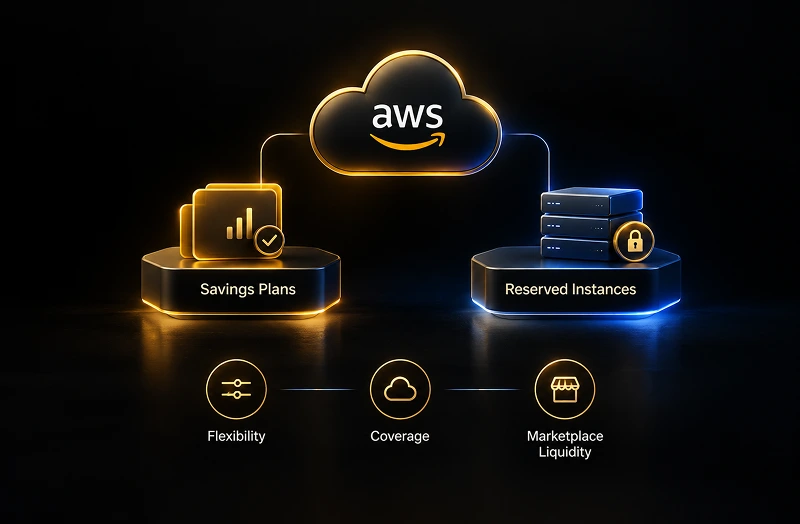
Understanding the operational differences between AWS Savings Plans (SPs) and Reserved Instances (RIs) empowers organizations to build a resilient, hybrid discount strategy. In this decision guide, we break down how both options compare on flexibility, coverage, and marketplace liquidity, helping enterprise decision-makers optimize cloud spend with confidence.
The Core Mechanical Shift: Commitment Styles Explained
To make informed financial choices, we must first look at what each model actually commits your organization to: a specific hourly dollar spend versus a specific infrastructure footprint.
AWS Savings Plans: Committing to Spend ($/Hour)
Introduced to streamline discount management, Savings Plans require a commitment to a consistent amount of compute spend measured in dollars per hour (e.g., $50/hour for 1 or 3 years).
- Automatic Discount Application: AWS automatically applies discounted rates to qualifying compute usage up to your committed hourly rate.
- Overages Handled Smoothly: Any usage beyond the committed dollar amount automatically reverts to standard On-Demand pricing without penalty.
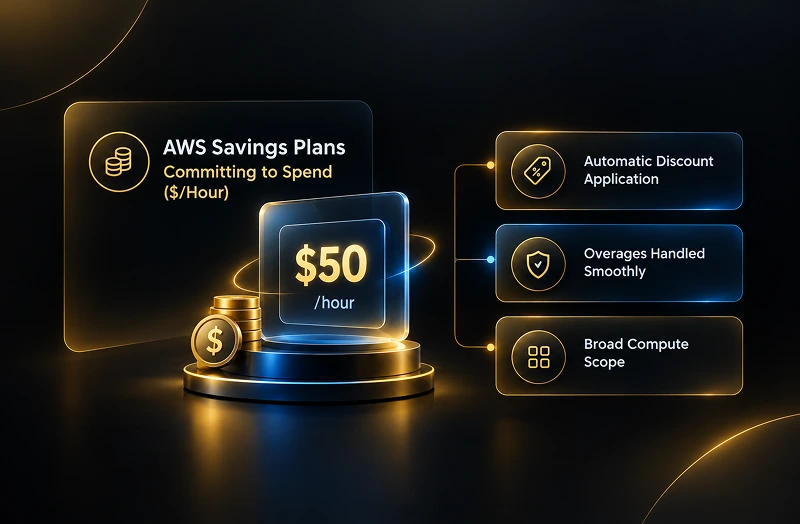
- Broad Compute Scope: Compute Savings Plans automatically float across instance families, operating systems, regions, and even compute types, including Amazon EC2, AWS Fargate, and AWS Lambda.
Reserved Instances: Committing to Resources (Capacity & Specs)
Reserved Instances function as a financial billing construct tied directly to specific infrastructure configurations.
- Targeted Resource Commitments: RIs apply discounts when you run instances matching specific attributes, such as instance family, operating system, tenant model, and AWS region.
- Non-Compute Services: While EC2 RIs have largely been superseded by Savings Plans, RIs remain essential for non-EC2 services like Amazon RDS, Amazon Redshift, Amazon ElastiCache, and Amazon OpenSearch Service.
Head-to-Head Comparison: The Executive Decision Matrix
To help your team quickly evaluate the strategic tradeoffs, we have synthesized the core operational differences between both mechanisms:
Key Decision Factors for 2026 Cloud Financial Management
Choosing between these structures isn't an either-or proposition. Modern enterprise FinOps teams frequently layer commitments to balance maximum discount depth against operational agility.
Workload Stability and Architectural Drift
If your engineering team is actively refactoring applications, moving from monolithic EC2 instances to serverless Fargate tasks or migrating architectures across regions, Compute Savings Plans provide unmatched protection. They ensure your commitment follows your architectural evolution automatically without administrative overhead.
Secondary Market Liquidity (The RI Advantage)
One major distinction involves commitment exit strategies. If an organization over-commits to an AWS Savings Plan, that hourly financial liability remains locked for the duration of the 1- or 3-year term.
Conversely, Standard Reserved Instances can be listed and resold on the third-party AWS Marketplace if your internal requirements change, offering a critical financial safety net for long-term planning.
Non-Compute Ecosystem Requirements
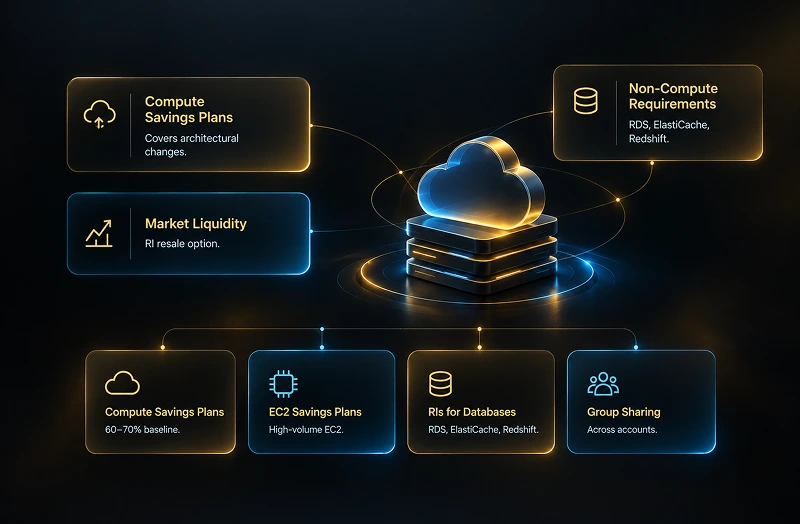
It is crucial to remember that Savings Plans do not cover specialized database and caching engines. For steady-state workloads running on Amazon RDS, Amazon ElastiCache, or Amazon Redshift, Reserved Instances remain the primary native instrument for securing long-term cost reductions.
Recommended Best Practices for Enterprise FinOps Teams
To maximize cost reductions while minimizing lock-in risks, we recommend following a structured, layered commitment strategy:
- Build a Base Layer with Compute Savings Plans: Cover 60% to 70% of your guaranteed, steady-state compute baseline using 1- or 3-year Compute Savings Plans. This absorbs architectural changes without risking unutilized commitments.
- Target High-Volume EC2 with EC2 Instance Savings Plans: For stable, legacy workloads that will remain on specific instance families within a single region, layer EC2 Instance Savings Plans to capture higher discount rates.
- Utilize RIs for Database Layers: Apply 1-year or 3-year Reserved Instances specifically across steady-state database nodes (RDS, ElastiCache, Redshift) where Savings Plans do not apply.
- Group Sharing and Organizational Governance: Enable commitment sharing across your AWS Organizations accounts, utilizing consolidated billing controls to ensure idle capacity in one business unit automatically covers usage in another.
Optimize Your AWS Cloud Strategy with Mirroar
Navigating cloud financial management and structuring optimal commitment portfolios requires deep analytical insight and continuous platform governance. Balancing risk, flexibility, and maximum discount rates is essential for driving predictable cloud margins.
At Mirroar, we partner with enterprise technology leaders and engineering teams to analyze, architect, and continuously optimize AWS cloud infrastructure spend.
Ready to eliminate wasted cloud spend and build a high-performing FinOps strategy? Connect with our consultative cloud advisory team at Mirroar today to schedule a comprehensive AWS commitment and cost-optimization assessment.