

Contrary to popular belief, Lorem Ipsum is not simply random text. It has roots in a piece of classical Latin literature from 45 BC, making it over 2000 years old.
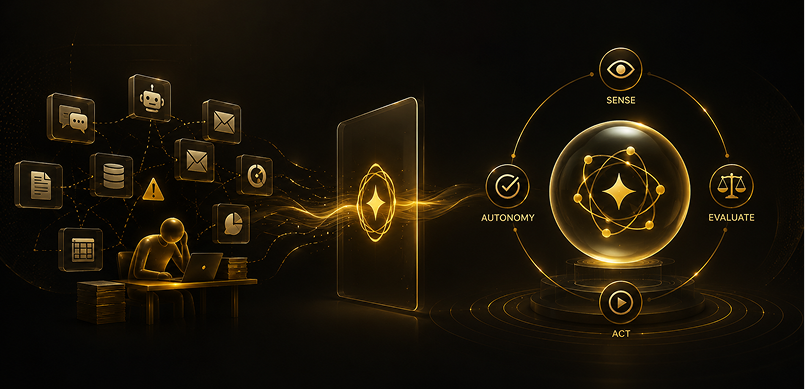
The corporate landscape is currently dominated by a fragmentation paradox. Enterprises deploy dozens of localized, task-based AI tools and siloed conversational bots. Yet, human talent remains bogged down—racing between administrative fire drills, triaging growing backlogs, manually updating system records, and navigating disconnected point solutions. Advisory AI has reached its operational limit. The enterprise requirement has shifted: organizations no longer need tools that merely offer recommendations; they require systems that can autonomously sense, evaluate, and act.
Unveiled at Knowledge 2026, ServiceNow is addressing this operational bottleneck by scaling its Autonomous Workforce model across every core corporate vector. Moving past isolated micro-automations, ServiceNow is deploying role-scoped AI Specialists. Engineered to function as specialized digital employees, these agents operate natively within established enterprise workflows to execute complex, multi-system processes from initiation to absolute resolution without requiring human intervention.
What separates these AI specialists from legacy automation is their shared native foundation. Rather than functioning as disjointed add-ons that worsen technical debt, they are built directly into the core platform by default.
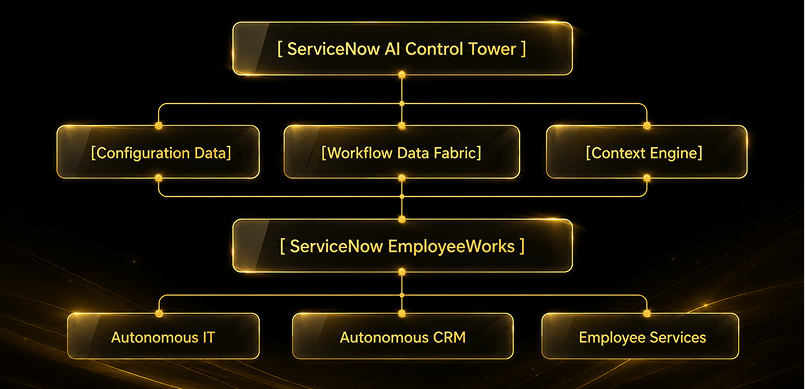
This single-platform architecture equips every digital worker with identical underlying operational intelligence:
Furthermore, this infrastructure is built to leverage preexisting technology ecosystems. Through partnerships with Amazon Web Services (AWS), Google Cloud, Microsoft, and NVIDIA—incorporating the NVIDIA Agent Toolkit and the NVIDIA AI-Q Deep Research specialist agent blueprint—enterprises can run these autonomous models across their existing infrastructure using a flexible blend of open and closed LLMs.
Autonomous IT: Transitioning to Systemic Resilience
IT organizations are perpetually buried under infrastructure alerts, unresolved ticket backlogs, and security patches. To mitigate this, ServiceNow’s L1 IT Service Desk AI Specialist—which demonstrated a 99% reduction in case resolution times within ServiceNow’s own internal help desk—is being joined by a new wave of specialized IT agents.
Autonomous CRM: Shifting from Tracking to Fulfillment
Traditional CRM systems function as passive ledgers for sales records and service tickets; they do not actually execute back-office fulfillment. Consequently, sales representatives lose all but 10 hours of their week to administrative overhead, while customer service agents must navigate three to five separate applications to settle a single dispute.
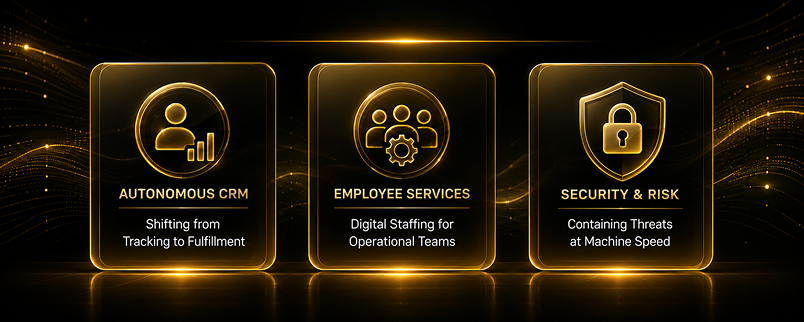
Autonomous CRM bridges the gap between customer-facing interactions and backend delivery. Processing over 100 million cases, orchestrating 16 million orders, and managing more than 7 million quote configurations monthly across the ServiceNow ecosystem, these specialized agents automate operations across the entire lifecycle. They handle everything from extracting transcription data to generate precise custom quotes, to resolving invoice disputes, processing complex orders, and executing renewals across channels.
Employee Services: Digital Staffing for Operational Teams
Back-office functions like HR, procurement, legal, and finance are regularly throttled by rising case volumes and manual triaging delays. By assigning digital employees equipped with specific role-based competencies to these queues, enterprises achieve a 91% case resolution rate without requiring a single manual reassignment. Routine inquiries are intercepted and deflected before transforming into formal tickets, freeing up human professionals to focus exclusively on high-value initiatives like contract negotiations, supplier strategy, and workforce planning.
Security & Risk: Containing Threats at Machine Speed
As the enterprise attack surface expands, security operation centers (SOCs) are overwhelmed by phishing attempts and system vulnerabilities. The Security & Risk AI specialists are engineered to compress investigative timelines from days to minutes. These agents autonomously triage vulnerabilities—extending down to hardware-level flaws—while screening third-party vendor risks to deliver instantaneous risk profiles. When active threats occur, they investigate and isolate the vectors while keeping human security professionals in the loop for high-consequence containment decisions.
Early adoptions across diverse sectors demonstrate that autonomous execution yields immediate operational dividends:
By anchoring these autonomous specialists onto a unified platform, Mirroar enables organizations to extract maximum value from their existing digital investments—accelerating business transformation without introducing architectural complexity.


