

Contrary to popular belief, Lorem Ipsum is not simply random text. It has roots in a piece of classical Latin literature from 45 BC, making it over 2000 years old.
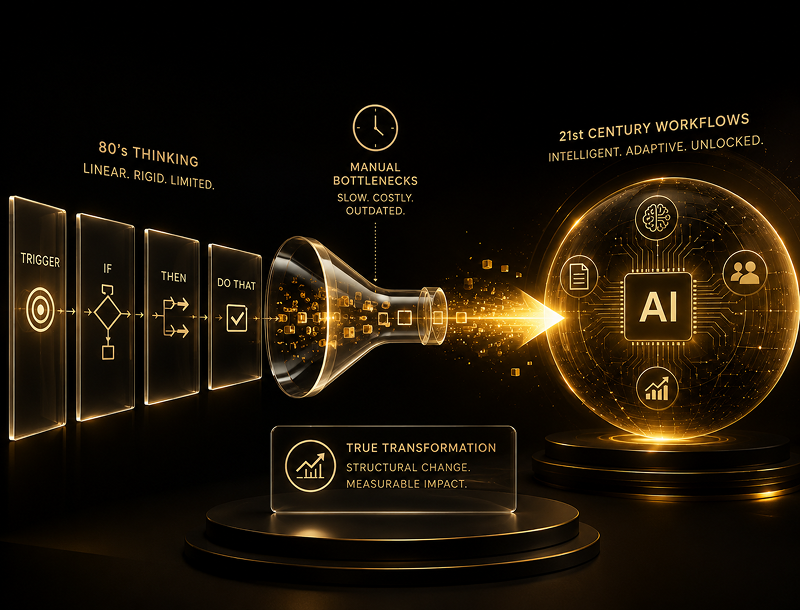
The current workflow automation market is a massive $26 billion industry. Yet, it remains anchored to a rigid, decades-old premise: "If this happens, do that." While this linear conditional logic has kept enterprises running since the mid-1980s, it has officially become the invisible ceiling holding back modern AI deployments.
The core issue isn't the maturity of artificial intelligence—it is the underlying operating model. Organizations are attempting to launch 21st-century AI agents into inflexible, 20th-century linear processes. This architectural mismatch creates a digital bottleneck: an advanced AI tool can draft a highly complex enterprise contract in mere seconds, only for that asset to sit stagnant in a manual approval queue for days. The workflow simply wasn't engineered for machines capable of cognitive processing.
Data confirms that while AI adoption is nearly universal, true structural transformation is remarkably rare. According to McKinsey’s 2025 State of AI survey, 88% of organizations have deployed AI within at least one business function. However, the majority have failed to embed these tools deeply enough into core workflows to capture material, enterprise-level benefits. BCG’s AI Radar 2026 reinforces this reality, revealing that while 94% of companies are scaling up their AI expenditures, a meager 15% are actually targeting the large-scale structural re-engineering required to achieve a financial return.
Enterprise ecosystems have suffered from six decades of fragmented legacy environments and siloed systems. Fulfilling a single workflow traditionally mandates multiple manual friction points across disconnected software and functional departments. Among dozens of organizational attributes analyzed by McKinsey, workflow redesign—not budget size, talent acquisition, or LLM selection—emerges as the single most critical determinant of whether an enterprise realizes a tangible financial return on AI.
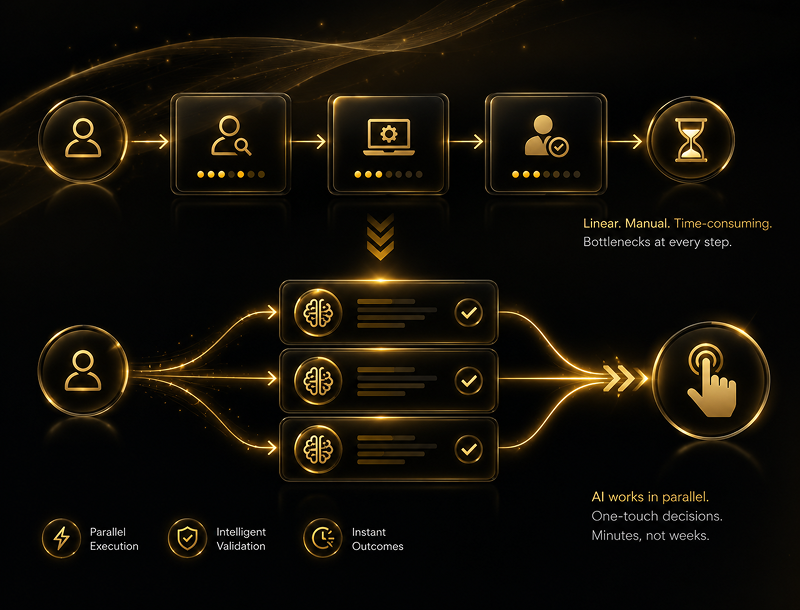
To unlock genuine value, leaders must distinguish between mere incremental efficiency and absolute transformation. Legacy automation focused on optimization—doing the exact same tasks, just marginally faster. Conversely, AI-native workflows fundamentally restructure how work is achieved, questioning whether certain legacy steps should exist at all.
Traditional processes were built around human cognitive limitations; we organize work sequentially and linearly to prevent operational overwhelm. AI, however, excels within the complexity of simultaneous orchestration.
In an AI-native architecture, sequential handoffs are replaced by parallel execution. Consider enterprise onboarding: instead of a slow relay race between HR, IT, and department heads to provision tools, the system deploys multiple autonomous AI agents simultaneously. One agent verifies eligibility criteria, another cross-references mandatory training compliance, and a third populates a one-touch approval mechanism for the manager. What once consumed days is compressed into minutes—not because individual sub-tasks are accelerated, but because the systemic wait times between them are structurally eliminated.
To prevent simultaneous execution from devolving into operational chaos, a governance and orchestration layer is required. Utilizing a framework like the ServiceNow AI Control Tower provides centralized oversight. This control layer maintains real-time visibility across every concurrent action while systematically enforcing corporate compliance and access policies. The result is an environment where independent AI specialists execute tasks at scale while remaining fully aligned, governed, and secure.
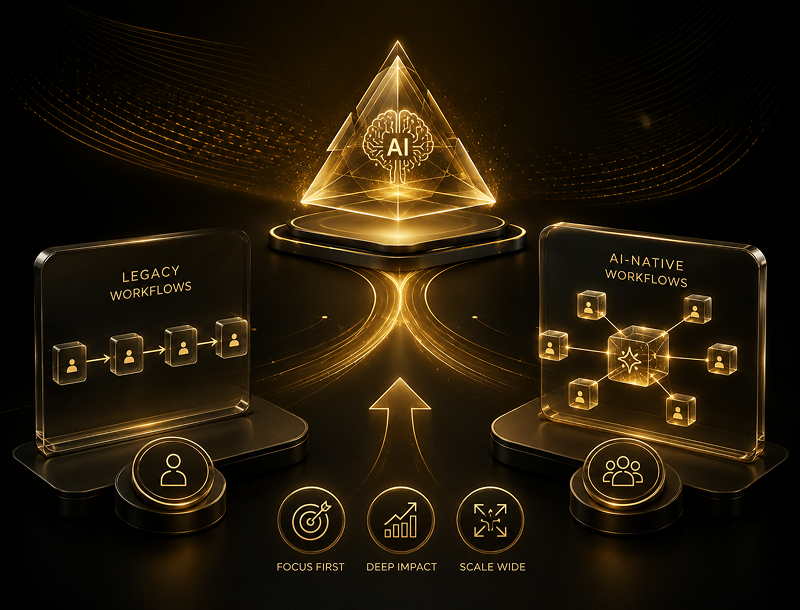
Transitioning away from a legacy mess requires organizations to move beyond treating AI as an isolated add-on tool and begin anchoring it as a foundational architectural layer.
According to PwC’s 2026 AI Business Predictions, the most successful strategy is to go narrow and deep before scaling wide. Rather than diluting resources by spreading AI superficially across every department, high-performing enterprises isolate a small cluster of high-value workflows where the operational friction is highest and the potential payoff is greatest. They then concentrate their technical resources, engineering talent, and change management frameworks entirely on optimizing those specific target areas first.
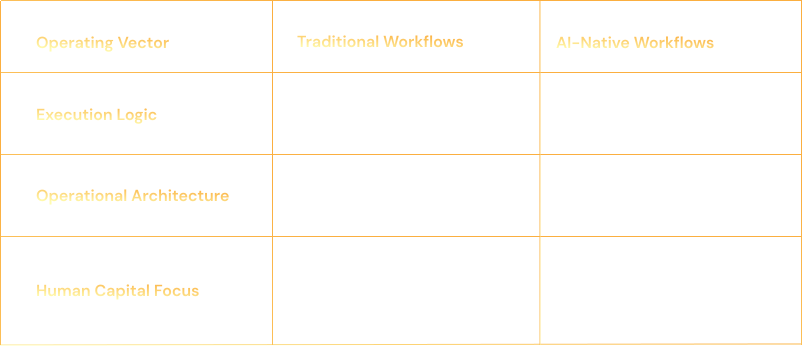
When workflows are rebuilt from the ground up, the nature of human labor shifts. AI-native designs do not erase human judgment; they strategically relocate it. Highly repetitive, rules-based tasks are entirely automated, while complex, high-consequence edge cases are escalated to human professionals equipped with superior institutional context.
Instead of burning billable hours managing manual handoffs and chasing administrative approvals, employees shift their focus toward strategic oversight and exception handling. Data from Deloitte’s 2026 State of AI in the Enterprise highlights that only 34% of organizations are actively reimagining their business models. The remaining majority face a steep integration barrier: the AI skills gap. Most corporate training programs mistakenly focus on teaching employees how to use specific software tools, rather than educating them on how to redesign the very operational roles they occupy.
This educational deficit is prompting a shift within higher education to bridge the gap between pure technology and business strategy. Academic institutions, such as Boston University’s Questrom School of Business, have institutionalized graduate curricula specifically focused on process mapping and workflow redesign. These programs train future leaders to pinpoint exactly where enterprise decisions occur, identify structural bottlenecks, and discover where AI can augment operations without introducing new points of failure.
Furthermore, specialized business education is adjusting rapidly; between 2022 and 2025, graduate-level AI degrees integrated within business schools exploded by 1,200%. This shift acknowledges that the long-term ROI of artificial intelligence is ultimately an operating model challenge—one that Mirroar is uniquely positioned to help enterprises solve by engineering AI-native foundations.


