Bridging IT and OT: How ServiceNow Modernizes Operational Technology in Heavy Manufacturing
Walk through a modern heavy manufacturing plant, and you will notice a stark structural divide. On one side, corporate IT departments operate in highly digitized, cloud-connected environments. On the other side, shop-floor engineers manage legacy physical infrastructure, programmable logic controllers (PLCs), and robotic assembly lines that were built for physical durability rather than digital connectivity.
When these two worlds remain isolated, production stalls, security vulnerabilities multiply, and maintenance becomes purely reactive.
Successfully
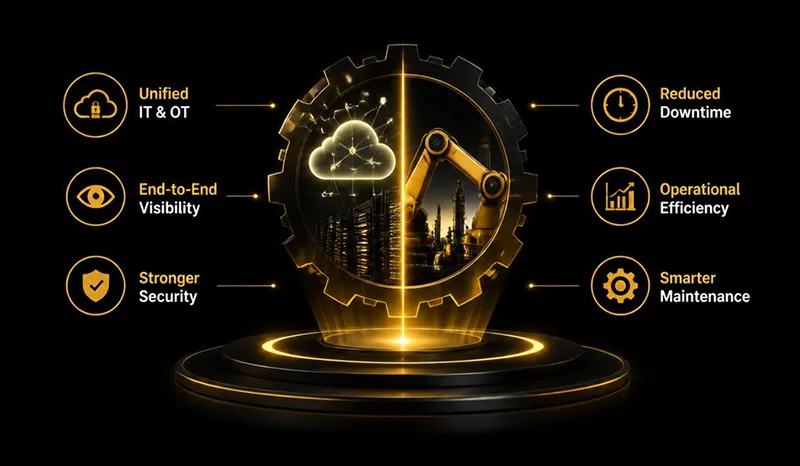
bridging IT and OT: how ServiceNow modernizes operational technology in heavy manufacturing has evolved from an administrative goal into a core commercial necessity. By unifying enterprise IT systems with industrial operational technology, manufacturers can gain total visibility over their physical assets, minimize unplanned downtime, and defend against emerging industrial cyber threats.
In this deep dive, we explore why the IT/OT divide persists, how ServiceNow bridges this gap without disrupting active production lines, and how forward-thinking manufacturers are building unified operational ecosystems.
The Friction Point: Why the IT/OT Divide Persists in Heavy Industry
For decades, Information Technology (IT) and Operational Technology (OT) developed along entirely separate trajectories with contrasting business priorities.
Differing Priorities and System Paradigms
Corporate IT prioritizes data confidentiality, rapid software updates, and centralized cloud governance. Conversely, operational technology on the factory floor values safety, system availability, and uninterrupted uptime above all else.
In heavy manufacturing environments, such as steel production, automotive assembly, or chemical processing, stopping a machine line to install a security patch can cost hundreds of thousands of dollars per hour in lost throughput. As a result, OT systems are often kept isolated or left running on legacy software long past standard lifecycle timelines.
The Hidden Cost of Operational Blind Spots
When OT assets operate outside standard IT visibility, heavy manufacturers face significant operational risks:
- Siloed Asset Inventories: Plant managers frequently rely on manual spreadsheets or localized databases to track equipment, leading to incomplete records of active software, firmware, and hardware versions.
- Reactive Maintenance Cycles: Equipment failures are often addressed only after a line breaks down, resulting in emergency maintenance costs and extended operational delays.
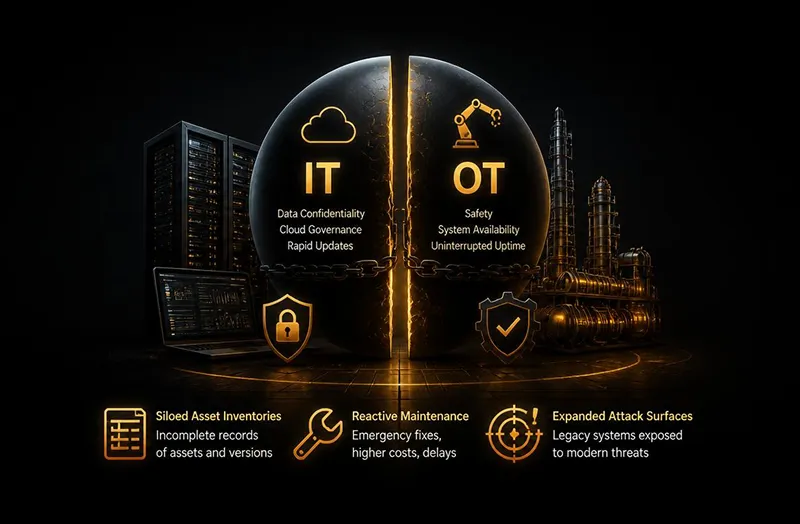
- Expanded Attack Surfaces: As industrial equipment is connected to IP networks for smart data collection, air-gapped legacy systems become exposed to modern cyber vulnerabilities without standard security monitoring.
Unifying Industrial Workflows with ServiceNow OT Management
To overcome these operational silos, heavy manufacturers require a centralized platform that can digest industrial protocols, contextualize physical assets, and standardize maintenance protocols across global facilities.
ServiceNow Operational Technology Management (OTM)
The ServiceNow platform addresses this challenge by extending its Enterprise Service Management capability directly onto the factory floor through ServiceNow Operational Technology Management (OTM). Rather than replacing existing industrial automation software or Supervisory Control and Data Acquisition (SCADA) systems, ServiceNow acts as a unified orchestrator that overlays existing infrastructure.
Core Functional Pillars of IT/OT Convergence
- Comprehensive OT Asset Discovery: Automatically discover, map, and contextualize physical machines, sensors, and controllers into an Operational Technology Configuration Management Database (OT CMDB). This gives engineering teams a single, live view of every connected device across all manufacturing sites.
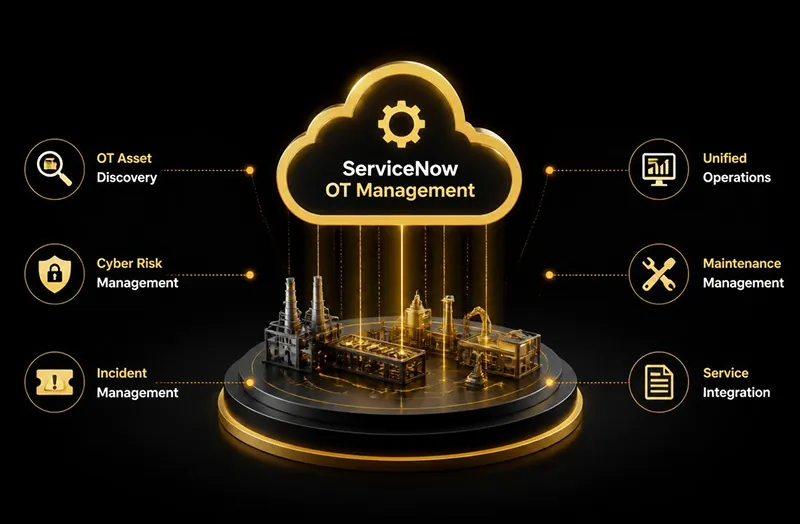
- Contextual Cyber Risk Management: By mapping industrial assets against known vulnerability databases, security teams can evaluate potential cyber risks based on operational criticality. If a vulnerability affects a non-critical sensor, patching can be scheduled during routine maintenance; if it threatens an active production line, mitigating controls can be deployed instantly.
- Unified Service and Incident Management: When a machine signals an anomaly or operational error, ServiceNow automatically generates a standardized incident ticket. This routes contextual data directly to field service technicians, ensuring they arrive with the exact tools, documentation, and replacement parts required.
Real-World Value: Transforming Factory Floor Operations
Implementing a structured framework for bridging IT and OT: how ServiceNow modernizes operational technology in heavy manufacturing delivers direct improvements to key operational metrics.
Shifting from Reactive Repair to Predictive Uptime
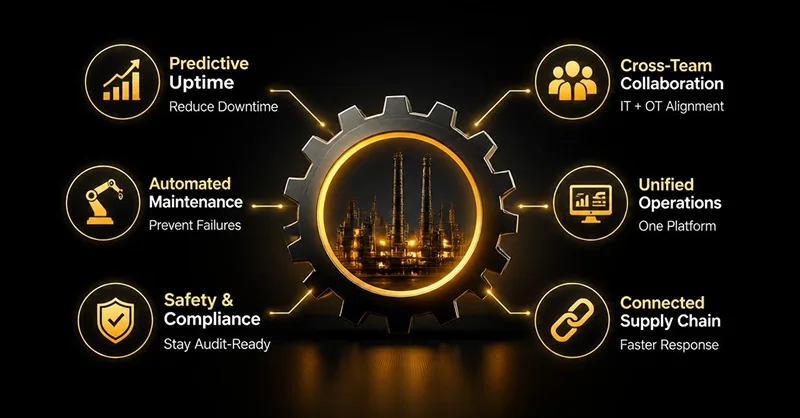
Unplanned downtime remains one of the largest expenses in heavy manufacturing. By connecting internet-of-things (IoT) telemetry and OT asset histories directly into ServiceNow, plant managers can transition from reactive firefighting to automated predictive maintenance.
When sensor readings indicate abnormal heat, vibration, or voltage drops, the platform triggers preventive maintenance workflows automatically, resolving equipment wear before catastrophic mechanical failures occur.
Streamlining Cross-Departmental Collaboration
When IT and OT teams share a single platform, communication friction disappears. Plant engineers gain access to enterprise IT service desks, corporate cybersecurity protocols, and automated supply chain replenishment without navigating clunky administrative channels.
At the same time, IT executives gain clear, audit-ready governance over industrial infrastructure, ensuring compliance with global manufacturing standards and regional data security mandates.
Modernize Your Industrial Operations with Mirroar
Unifying shop-floor operational technology with enterprise cloud workflows demands deep technical expertise across both ServiceNow capabilities and industrial architecture. Building a resilient, connected manufacturing environment requires a strategy designed to protect uptime while accelerating digital transformation.
At
Mirroar, we help manufacturing enterprises and technology leaders design, deploy, and optimize ServiceNow solutions built to handle complex industrial operations.
Ready to bridge the gap between your IT systems and factory floor operations? Connect with our consultative advisory team at Mirroar toda to schedule a comprehensive industrial workflow assessment.