

Contrary to popular belief, Lorem Ipsum is not simply random text. It has roots in a piece of classical Latin literature from 45 BC, making it over 2000 years old.
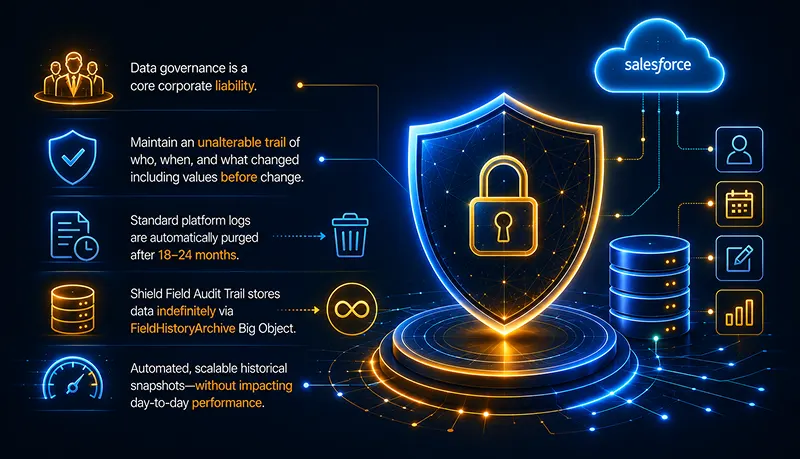
For C-suite executives and risk management leaders, data governance has shifted from an operational checkbox to a core corporate liability. Modern regulatory frameworks—including GDPR, HIPAA, and Sarbanes-Oxley (SOX)—impose substantial financial and reputational penalties on organizations unable to defend their historical data lifecycle.
When external auditors target a CRM environment, a static view of current customer profiles is legally insufficient. To satisfy advanced security standards, your platform must maintain an unalterable trail establishing exactly who adjusted a data point, when the transaction occurred, and what values existed before the modification.
While standard Salesforce tracking addresses initial developer requirements, it lacks the longevity and scale demanded by corporate enterprise audits. To insulate the enterprise from compliance exposure, Salesforce Shield: Field Audit Trail (FAT) modernizes your platform architecture by creating automated, scalable historical snapshots without impacting day-to-day transaction speeds.
Standard field history tracking introduces critical operational constraints when applied to enterprise-grade auditing schedules. Transitioning to Salesforce Shield changes your compliance coverage parameters:
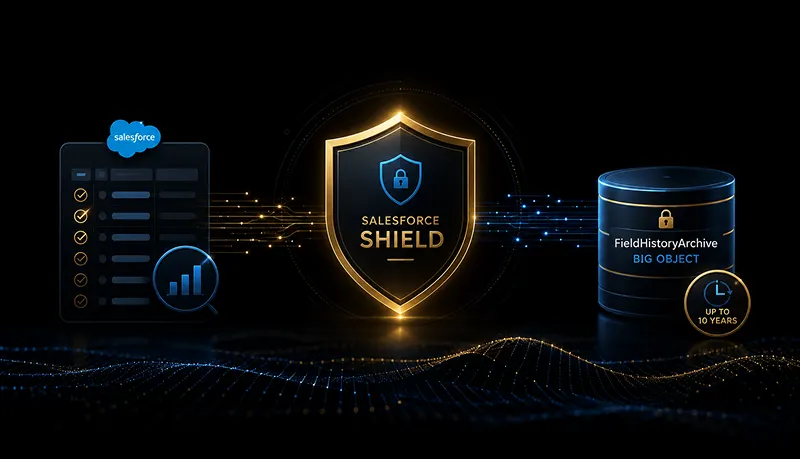
To determine the ideal data protection policy for your organization, adjust your regulatory parameters below to see how the underlying Salesforce storage model adapts.
Implementing Field Audit Trail introduces three native structural protections designed to decouple operational runtime performance from historical data auditing loops.
The Big Object Pipeline
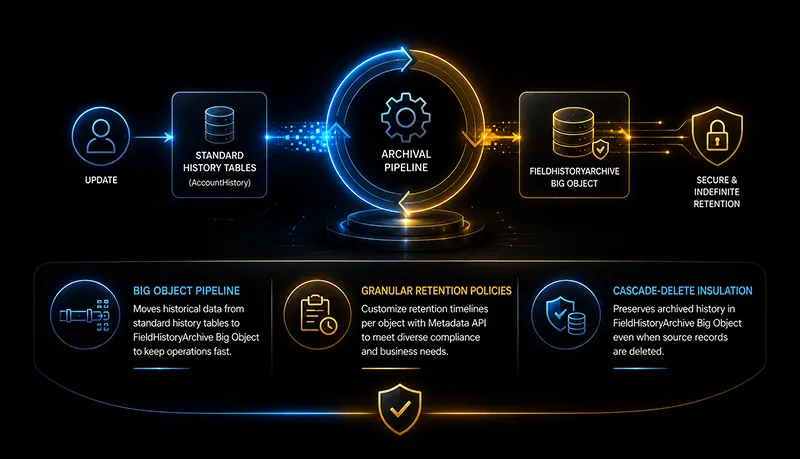
When a user updates a monitored field, Salesforce initially records the event in standard history tables (such as AccountHistory). According to your defined metadata policies, Salesforce periodically moves this information out of active production tables and writes it into the FieldHistoryArchive Big Object repository. This archival loop ensures that mass search queries and reporting workflows do not experience performance lag as historical logs grow.
Granular Retention Policies
Corporate compliance guidelines rarely require uniform retention timelines for every single department or record class. Through the Metadata API, developers can customize the HistoryRetentionPolicy component on an object-by-object basis. This lets a company preserve high-risk contract histories for 10 years to satisfy financial audit requirements, while configuring short-term lead objects to delete data sooner to comply with privacy laws.
Cascade-Delete Insulation
Standard Salesforce environments can create auditing gaps because deleting a primary record automatically wipes out its nested historical relationship logs. Field Audit Trail resolves this risk via a specialized data protection layer:
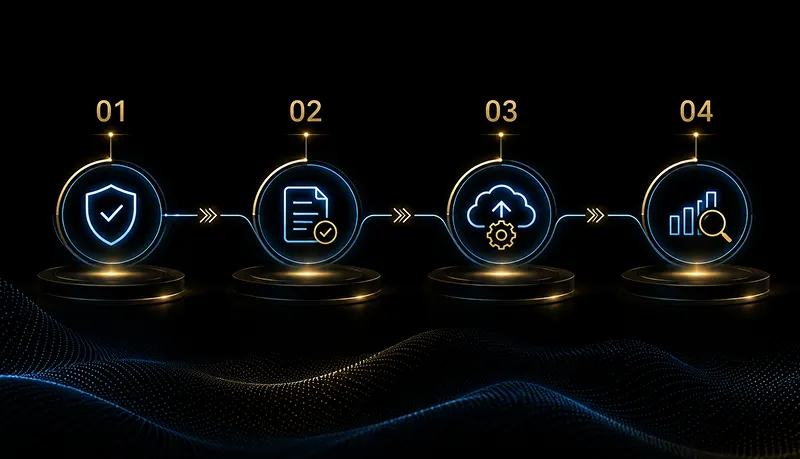
Activating Field Audit Trail requires configuring field history states alongside structured Metadata API deployments to define your enterprise archival parameters.
Verify Licensing and Core Access:Prerequisites.
Confirm your org uses Enterprise, Performance, or Unlimited editions with an active Salesforce Shield or Field Audit Trail add-on license. Assign the "Customize Application" permission set to your deployment engineer.
Select High-Priority Fields:Configuration.
Open the Object Manager, locate your target object, and click "Set History Tracking." Check up to 200 fields containing
critical PII, financial information, or operational metrics.
Deploy Retention Rules via Metadata API:Orchestration.
Define your precise retention timelines using an XML metadata manifest file. To archive records after 6 months and retain them for 10 years, apply this structure to your object metadata file: Deploy the configuration package directly into production using the Salesforce CLI (sf project deploy start).
Establish Advanced Audit Extraction:Governance.
Because archived rows sit within a specialized Big Object table, standard Salesforce operational reports cannot view entries beyond the initial 18-month production buffer. Instruct your IT team to build standardized extraction scripts utilizing Asynchronous SOQL or REST APIs to populate your corporate audit dashboards.
Migrating your transaction logging architecture to Salesforce Shield FAT balances systemic risk reduction with infrastructure efficiency:
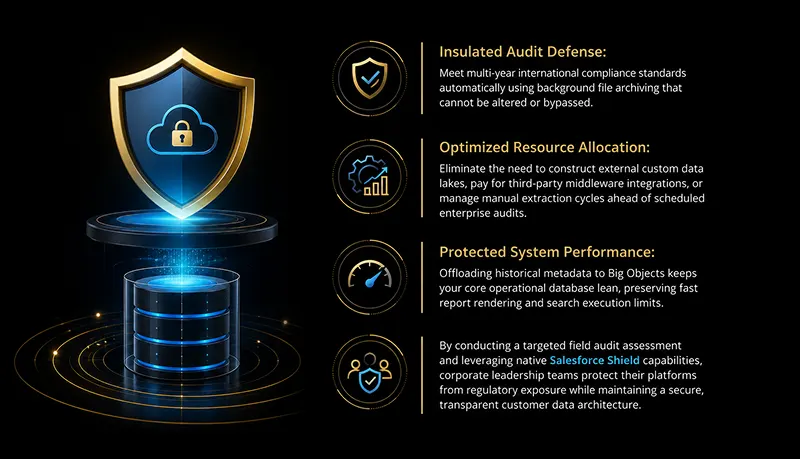
By conducting a targeted field audit assessment and leveraging native Salesforce Shield capabilities, corporate leadership teams protect their platforms from regulatory exposure while maintaining a secure, transparent customer data architecture.
Ready to fortify your CRM compliance framework? Select a strategic path below:
Request a Data Sensitivity Mapping Session
Compare Field Audit Trail vs. Event Monitoring


