Eliminating Alert Noise and Event Fatigue in ServiceNow ITOM Health
Enterprise IT environments generate massive volumes of monitoring data daily. Infrastructure management tools like Dynatrace, Datadog, SolarWinds, and Sentry continuously fire raw performance events into ServiceNow Event Management. Without a structured filtering model, this constant flood turns into severe alert noise.
Duplicate incidents inundate support queues, obscuring critical system outages and draining fulfiller productivity. When support teams spend their shifts triaging false positives, mean time to resolution (MTTR) worsens and operational resilience declines.
The Technical Failures Driving Alert Fatigue
This operational drag occurs when event pipelines lack automated governance, intelligent filtering, and precise binding rules. When monitoring tools operate in isolation, raw alerts bypass structured validation before entering the service management lifecycle:
- Failed CMDB Binding: Raw events often lack standardized identifiers, failing to map directly to Configuration Items (CIs) in the Configuration Management Database (CMDB). This creates orphan alerts and triggers duplicate incident tickets for a single underlying server or application issue.
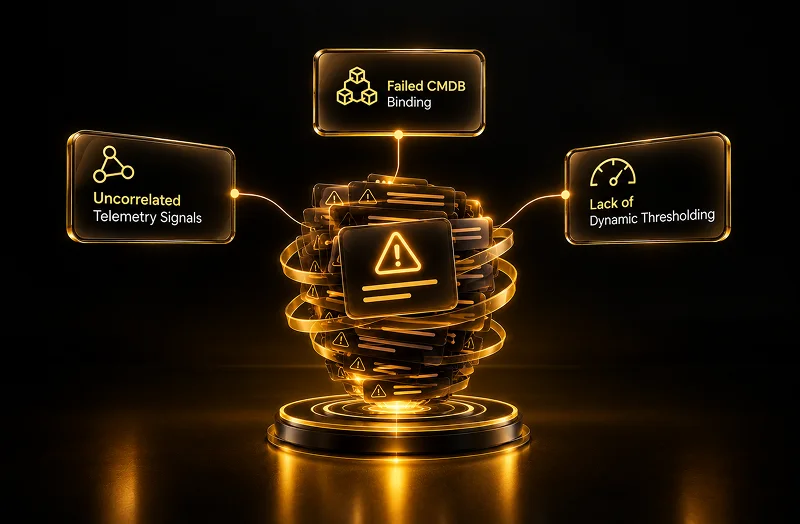
- Uncorrelated Telemetry Signals: Without native AIOps and Health Log Analytics, system notifications remain isolated. Instead of recognizing that a network spike, memory threshold breach, and database timeout are linked to one service failure, legacy setups create separate ticket queues for every affected sub-component.
- Lack of Dynamic Thresholding: Static alert rules trigger warnings during routine background jobs or scheduled maintenance, generating noise that obscures genuine operational threats.
Architectural Deep Dive: How Mirroar Engineers ITOM Event Management
At Mirroar, we transform chaotic monitoring queues into streamlined, automated resolution engines. Following ServiceNow best practices and the Common Service Data Model (CSDM), our team deploys a three-tiered technical architecture designed to resolve alert noise at its origin.
Advanced Event Rules and Automated CMDB Binding
Before an event becomes an actionable alert, it must pass through ServiceNow Event Rules. We design rule sets to parse, transform, and clean raw payloads on ingestion:
Payload Normalization: We standardize field naming conventions across diverse monitoring vendors so severity levels and descriptions match native ServiceNow taxonomy.
Automated CI Binding: Using attributes like IP addresses, hostnames, and MAC addresses, our rules bind incoming events to specific CIs in the CMDB via the Identification and Reconciliation Engine (IRE), preventing orphan alerts.
Pre-Alert De-duplication: We establish deduplication keys that automatically group identical incoming event messages from the same resource, updating the existing alert record rather than logging duplicate entries.
Topology-Based AIOps and Metric Intelligence
Once events are normalized and bound to the CMDB,
Mirroar leverages ServiceNow AIOps and Health Log Analytics to aggregate correlated signals:
Topological Correlation: Using dynamic service maps built on CSDM architecture, AIOps evaluates relationship dependencies between CIs. If an upstream database server fails, downstream application alerts automatically aggregate under a single Primary Alert.
Metric Anomaly Detection: We configure machine learning models to establish operational baselines across metric data, allowing the platform to flag true operational deviations while ignoring harmless operational spikes.
Dynamic Alert-to-Incident Automation Rules
To prevent ticket bloat, we implement strict automated governance for incident creation:
Actionable Threshold Enforcement: ServiceNow automatically triggers IT Service Management (ITSM) Incidents only for high-severity, actionable Primary Alerts that affect active Business Service Offerings.
Automated Remediation Workflows: For known recurring issues, we link Primary Alerts directly to Flow Designer actions, executing self-healing scripts (e.g., restarting a service or clearing disk space) before an agent ever needs to touch a ticket.
Enterprise Impact: Why Partnering with Mirroar Matters
Modernizing your ITOM environment with Mirroar turns passive infrastructure data into proactive business intelligence. By establishing automated event pipelines, we help enterprises achieve:
- Up to 90% Reduction in Alert Volume: Filtering out benign noise allows fulfillers to focus exclusively on high-priority events.
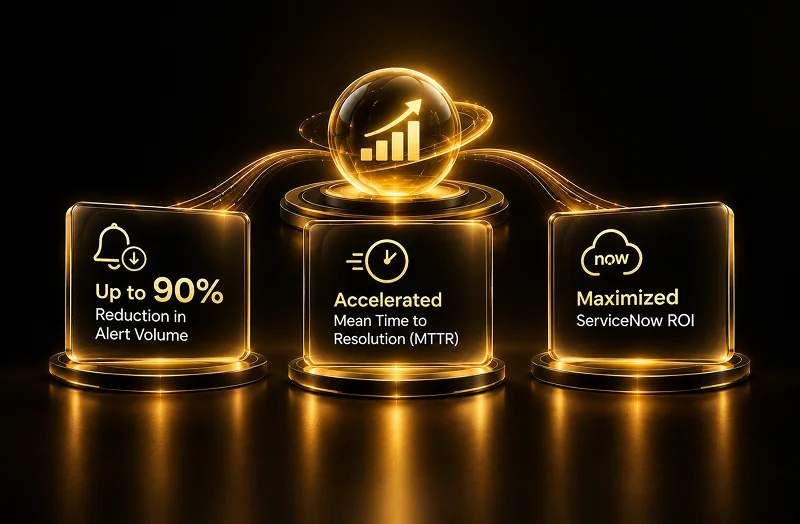
- Accelerated Mean Time to Resolution (MTTR): Clear CI binding and primary alert correlation ensure operators identify root causes instantly within the Service Operations Workspace (SOW).
- Maximized ServiceNow ROI: Connecting ITOM Health seamlessly with ITSM and the CMDB unlocks the full value of your enterprise platform investment.
Conclusion
Overcoming alert fatigue requires moving beyond reactive event tracking to intelligent, automated operations management. By pairing ServiceNow’s native AIOps capabilities with Mirroar’s consultative deployment framework, enterprise teams protect system uptime while empowering fulfillers to focus on strategic tasks.
Ready to eliminate alert noise and modernize your IT Operations Management? Connect with the
Mirroar ITOM expert team today to architect a resilient, intelligent enterprise infrastructure.



