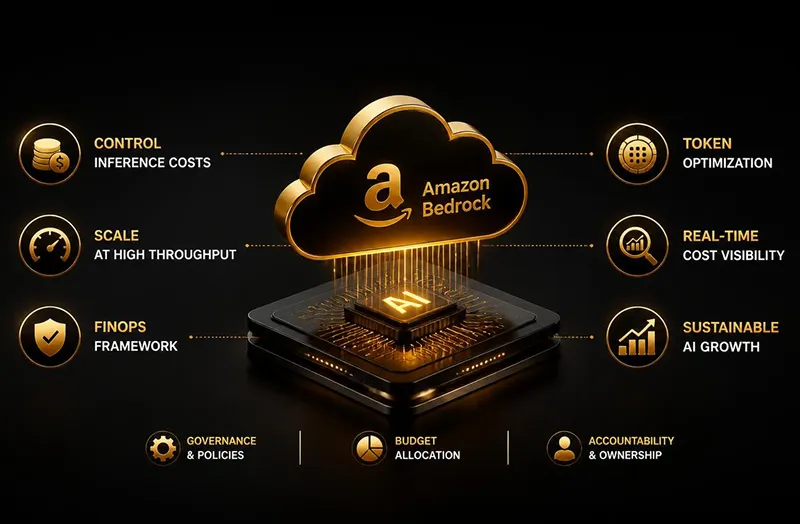
FinOps Frameworks for GenAI: How to Control Amazon Bedrock Inference Costs at Scale
Deploying generative AI from a sandboxed prototype into high-throughput production is an exhilarating milestone for any enterprise engineering team. However, the initial thrill often gives way to sharp friction when the first monthly cloud statement arrives. Unlike traditional cloud workloads, where compute costs scale linearly with uptime or predictable server utilization, generative AI pricing is tightly bound to variable token metrics, prompt context windows, and dynamic inference demands.
Without structured governance, adopting
FinOps frameworks for GenAI: how to control Amazon Bedrock inference costs at scale becomes the defining challenge for maintaining healthy operating margins while driving innovation.
In this strategic guide, we break down why generative AI infrastructure breaks legacy cloud billing models, how Amazon Bedrock serves as a foundation for scalable AI deployment, and the exact financial engineering frameworks required to optimize your inference spend across every workload tier.
Why Generative AI Cost Management Demands a New FinOps Paradigm
Traditional cloud financial management (FinOps) relies on predictable baseline metrics: core CPUs, memory allocation, and hourly instance runtime. When managing standard virtual machines or container clusters, engineering teams can forecast spend with remarkable precision using historical usage curves and long-term capacity commitments.
Generative AI disrupts this operational predictability.
The Economics of Token Dynamics
When applications query Foundation Models (FMs) via Amazon Bedrock, pricing is primarily calculated per thousand or per million input and output tokens. This creates three distinct financial variables that standard cloud monitoring often overlooks:
- Asymmetric Token Pricing: Output tokens (the text or response generated by the model) are significantly more expensive to process than input tokens (the prompt or context provided to the model).
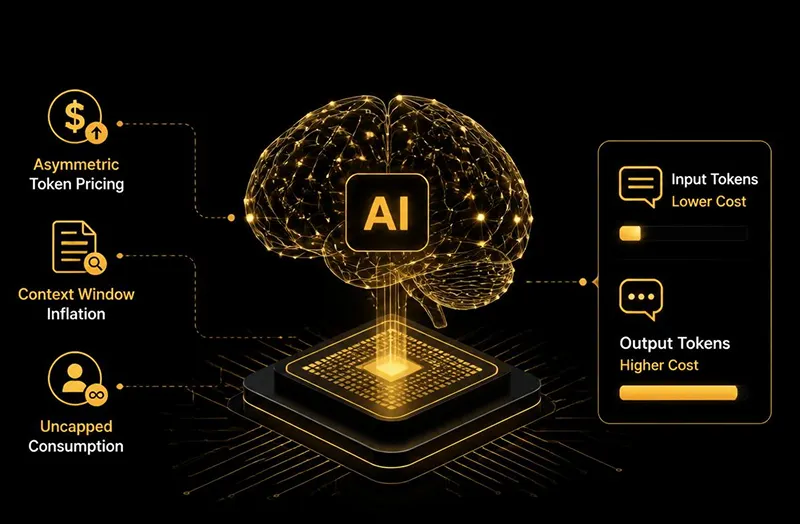
- Context Window Inflation: As teams implement Retrieval-Augmented Generation (RAG) to feed rich corporate documents into prompts, input token volumes expand exponentially, raising the baseline cost of every single query.
- Uncapped End-User Consumption: A single runaway agentic loop or an unoptimized user query can trigger thousands of sequential model calls, consuming substantial cloud budget within hours.
Understanding AWS and Amazon Bedrock: The Enterprise AI Foundation
To effectively control inference costs, technology leaders must understand the strategic role AWS plays in enabling enterprise-grade AI governance.
Why AWS is Critical for Enterprise AI Strategy
AWS provides the foundational cloud ecosystem required to run secure, compliant, and highly scalable workloads. Rather than forcing organizations to build proprietary infrastructure from scratch, AWS delivers the compute power, serverless architecture, and data isolation needed to deploy AI across complex global operations.
How Amazon Bedrock Shapes Model Financials
Amazon Bedrock acts as a fully managed, serverless integration layer that provides access to leading foundation models through a single, unified API. Because Bedrock abstracts away the heavy lifting of managing physical GPU clusters, it provides native cost-control mechanisms that standard custom deployments lack:
- Pay-as-You-Go Flexibility: Teams can experiment across multiple model families (such as Anthropic Claude, Amazon Nova, Meta Llama, and Mistral) without paying for idle server capacity.
- Provisioned Throughput: For high-traffic, predictable production workloads, Bedrock allows organizations to commit to dedicated model capacity (Provisioned Throughput) for specific durations, unlocking substantial cost savings compared to on-demand pricing.
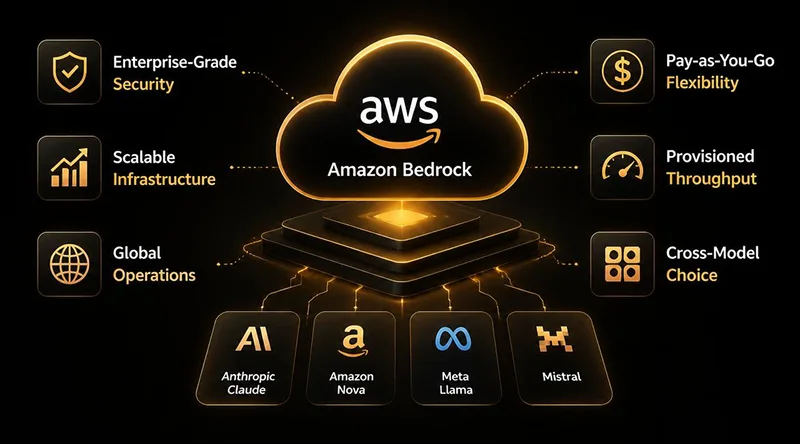
- Cross-Model Choice: Instead of locking an entire enterprise into a single, expensive multi-billion parameter model, Bedrock allows engineers to dynamically route simple tasks to lightweight models while reserving top-tier reasoning engines for complex multi-step queries.
Core FinOps Frameworks for Amazon Bedrock Inference Control
Implementing FinOps frameworks for GenAI: how to control Amazon Bedrock inference costs at scale requires a multi-layered approach that bridges engineering decisions with financial oversight. At Mirroar, we recommend structuring your cloud AI financial policy around four core operational pillars:
Pillar A: Intelligent Model Tiering and Smart Routing
The fastest way to drain an AI budget is using a massive, highly complex foundation model for basic operational tasks.
- Task-Based Categorization: Route simple classification, sentiment analysis, or basic text extraction to smaller, low-cost models (such as Amazon Nova Micro or Claude Haiku).
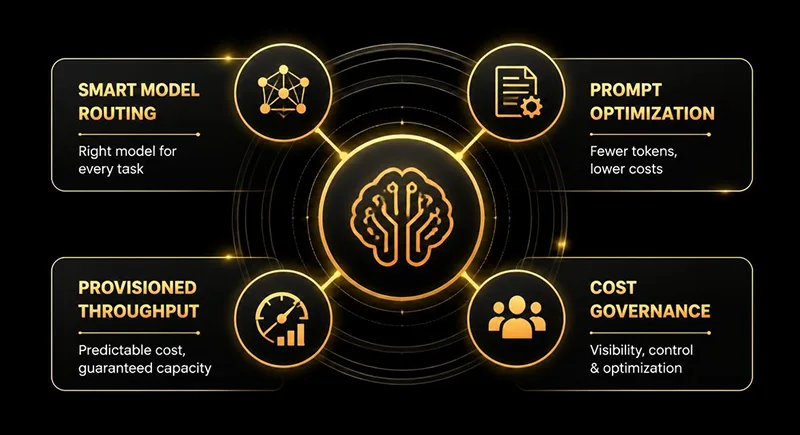
- Dynamic Query Orchestration: Build API middleware that evaluates query complexity in real time. If a user request requires simple retrieval, send it to a lightweight model; if it demands deep multi-step logic, escalate it to a frontier model.
Pillar B: Prompt Engineering and Token Reduction
Because input tokens directly dictate per-request billing, refining your data payloads delivers immediate financial returns.
- Semantic Compression: Strip out conversational fluff and redundant system instructions before passing text to the model API.
- Prompt Caching Strategies: Cache frequently used static context, such as corporate policy documents or system prompts, so the model doesn't re-process the exact same tokens on every inbound request.
Pillar C: Utilization of Provisioned Throughput vs. On-Demand
As application traffic stabilizes, moving away from pure on-demand pricing is essential for long-term margin optimization.
- On-Demand for Volatile Workloads: Use standard per-token pricing for development, staging, and unpredictable user-facing applications.
- Provisioned Throughput for Steady Baselines: For core production applications with steady, 24/7 traffic volumes, provision dedicated model units to lock in predictable monthly costs and guaranteed throughput.
Pillar D: Automated Guardrails and Rate Limiting
Financial control requires real-time enforcement before budget overruns occur.
- Hard Budget Caps via AWS Budgets: Set up automated cloud alarms that trigger alerts or temporarily throttle non-critical staging environments when daily spending thresholds are breached.
- Agentic Execution Limits: Configure Amazon Bedrock Guardrails and agent timeout limits to prevent infinite loops when autonomous AI agents execute complex business logic across internal databases.
Key Takeaways
- Shift from Static to Dynamic FinOps: Generative AI costs are driven by token volume, context windows, and model complexity, demanding real-time execution monitoring rather than monthly invoice reviews.
- Leverage Model Diversity: Using Amazon Bedrock, organizations can avoid over-provisioning by routing queries to the most cost-effective model tier capable of completing the task.
- Optimize Payloads First: Implementing prompt caching, semantic compression, and RAG optimization directly reduces input token consumption before queries hit the model.
- Automate Real-Time Governance: Combine AWS Budgets, rate-limiting guardrails, and Provisioned Throughput commitments to prevent cost spikes while scaling production workloads safely.
Master Your Cloud FinOps Architecture with Mirroar
Scaling generative AI without compromising operating margins is a core requirement for modern tech leadership. Navigating model selection, prompt optimization, and serverless cost governance requires an architectural strategy built for long-term efficiency.
At Mirroar, we help engineering leaders and executive teams design cost-optimized, highly resilient AWS environments that keep performance high and invoices low.
Ready to eliminate compute waste and gain full visibility over your AI spend? Connect with our consultative advisory team at Mirroar today to schedule a comprehensive FinOps and architecture assessment.