How We Think About AI Models: Building a Flexible Enterprise Strategy
Just months ago, selecting an artificial intelligence architecture felt like a permanent infrastructure commitment. Organizations evaluated major foundation providers, selected a core engine, and locked in their technical roadmaps. Today, that rigid single-model approach is a direct operational liability.
With foundational capabilities advancing in fast iteration cycles, locking an enterprise into a single vendor transfers research volatility directly to core business operations. Every time a provider deprecates an API or alters its pricing tiers, your platform absorbs the disruption.
At
Mirroar,
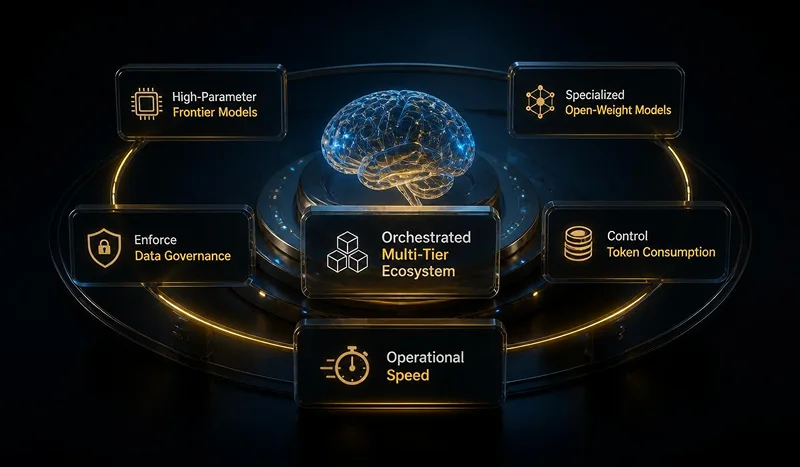
how we think about AI models mirrors ServiceNow’s core architecture: treating model selection not as a single choice, but as an orchestrated, multi-tier ecosystem. By balancing high-parameter frontier capabilities with specialized open-weight models, enterprise organizations gain agility, enforce data governance, and control token consumption without sacrificing operational speed.
3 Core Principles for Managing Enterprise AI Portfolios
Instead of forcing every business workflow into a single Large Language Model (LLM), a scalable platform strategy relies on routed, tiered intelligence tailored to specific operational requirements.
Match Cognitive Load to the Operational Task
Classifying high-volume IT incident tickets, summarizing complex case histories, and orchestrating multi-system agentic workflows demand fundamentally different levels of reasoning. Evaluating models solely on public benchmark scores fails to predict real-world performance on enterprise schemas.
We align model selection with specific functional demands across three main operational tiers:
- High-Volume Triage & Categorization: Lightweight, specialized domain models execute repetitive tasks at near-zero latency and minimal token cost.
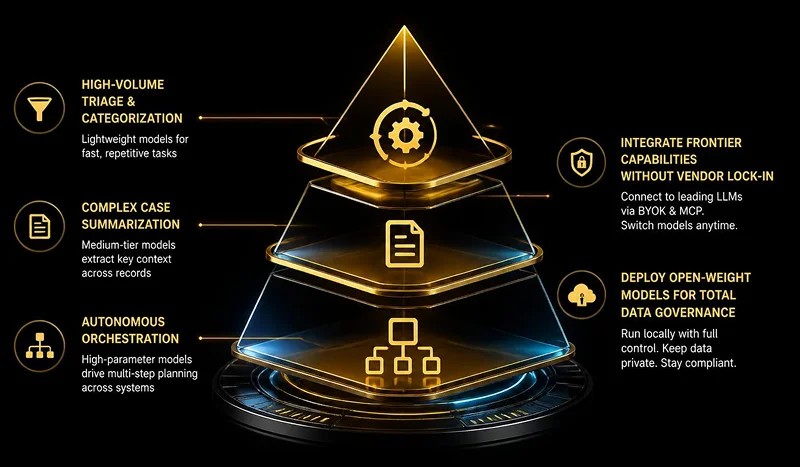
- Complex Case Summarization: Medium-tier models extract key entities and context across cross-departmental records.
- Autonomous Orchestration: High-parameter reasoning engines handle multi-step planning and dynamic process execution across legacy tools.
Integrate Frontier Capabilities Without Vendor Lock-In For complex reasoning and dynamic planning across multi-system environments, accessing top-tier frontier LLMs is critical. Through platform features like the ServiceNow AI Control Tower and native AI Gateway, organizations integrate leading external models, including OpenAI, Anthropic, and Google, using Bring Your Own Key (BYOK) configurations.
By standardizing runtime enforcement through the Model Context Protocol (MCP), the platform abstracts the underlying provider. If a superior model emerges, teams can re-route agentic workflows without rewriting custom code or rebuilding integrations.
Deploy Open-Weight Models for Total Data Governance For regulated environments operating under strict data residency mandates or sovereignty frameworks, public API connections present compliance risks. Open-weight models offer complete architectural visibility and local deployment flexibility.
Through connectors to platforms like Hugging Face, Databricks, and Snowflake, enterprises deploy open-weight models within their private cloud boundaries. This ensures sensitive corporate records and proprietary domain context never cross external networks.
Comparing Frontier APIs and Hosted Open-Weight Architectures
Understanding where to deploy frontier API models versus hosted open-weight models comes down to evaluating five key architectural dimensions:
- Primary Use Case: Frontier API models excel at advanced multi-step planning and complex agentic reasoning. Hosted open-weight models are best suited for data-sovereign tasks and localized execution.
- Deployment Model: Frontier models run via external APIs managed through an AI Gateway. Open-weight models are hosted directly inside your private cloud or VPC perimeter.
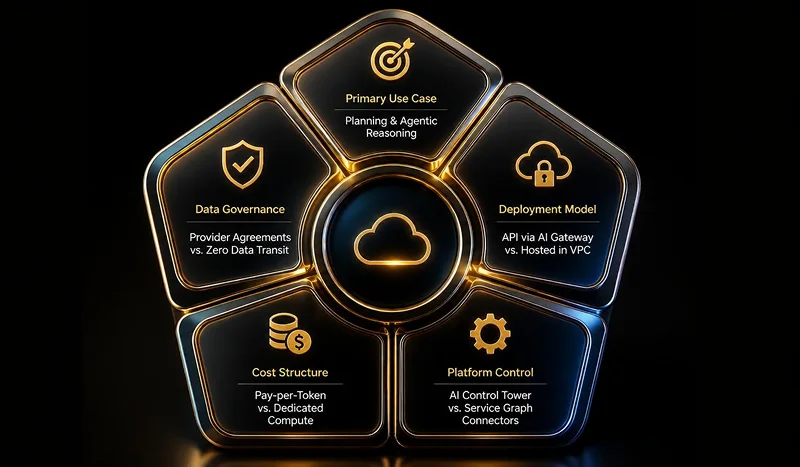
- Data Governance: Frontier models are governed by provider enterprise privacy agreements, whereas open-weight models ensure zero external data transit with complete lineage control.
- Cost Structure: Frontier APIs utilize a pay-per-token consumption model, while open-weight models rely on predictable hosting and dedicated compute infrastructure.
- Platform Control: Frontier integrations are managed centrally via AI Control Tower registries, while open-weight models integrate natively through Service Graph Connectors.
Future-Proofing Your Enterprise AI Strategy
Future-proofing your enterprise AI strategy isn't about betting on a single winning model. It requires building a unified governance layer where specialized, open-weight, and frontier LLMs operate safely within your core workflows.
Ready to architect a resilient, multi-model strategy on ServiceNow? Connect with the
Mirroar consulting team today to design an enterprise AI framework built for long-term operational scale.