Micro-Restoration Architecture: Safeguard Your S3 Buckets Against Autonomous AI Data Corruption
As enterprises race to integrate autonomous artificial intelligence agents, Retrieval-Augmented Generation (RAG) pipelines, and continuous model re-training loops, Amazon Simple Storage Service (Amazon S3) has become the core repository for corporate intelligence. S3 buckets house the raw training data, embeddings, and vector stores that power modern AI initiatives.
However, the rapid deployment of autonomous AI agents introduces an insidious risk: soft, gradual data corruption.
Unlike traditional ransomware that encrypts entire buckets in plain sight, autonomous agents with write access can subtly alter metadata, poison training datasets, or overwrite critical JSON objects over weeks. Implementing a
Micro-Restoration Architecture: safeguard your S3 buckets against autonomous AI data corruption strategy allows engineering teams to detect, isolate, and roll back single corrupted objects or specific data subsets instantly, without taking down entire storage environments.
In this strategic guide, we explore why traditional disaster recovery fails against AI data corruption, how micro-restoration works on AWS, and the architectural framework required to maintain resilient data lakes.
The Anatomy of AI-Driven Data Corruption in Cloud Storage
Traditional storage security focuses on preventing unauthorized external access or catastrophic deletion. Autonomous AI agents, however, operate inside your trusted security perimeter. When an LLM agent misinterprets an instruction or hallucinates during automated ETL (Extract, Transform, Load) tasks, the resulting data degradation is often invisible to legacy perimeter defenses.
Silent Data Poisoning vs. Catastrophic Loss
When evaluating risks to your S3 data lakes, the threat profile has evolved into two distinct patterns:
- Symptomatic Hard Failures: A rogue process deletes an entire bucket or encrypts millions of objects. These events trigger immediate operational alarms, allowing engineers to invoke traditional full-bucket disaster recovery backups.
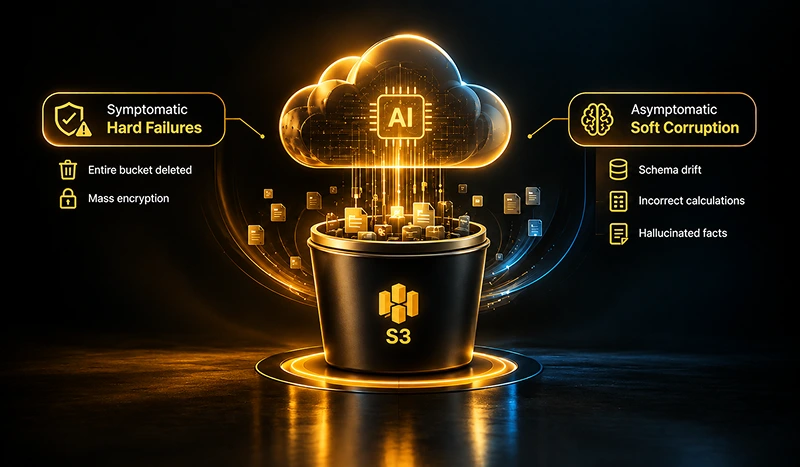
- Asymptomatic Soft Corruption: An autonomous agent continuously updates records with subtle schema drift, incorrect mathematical calculations, or hallucinated facts across millions of small objects. Because individual write operations appear valid to AWS Identity and Access Management (IAM), traditional security tools register no policy violations. By the time human operators notice that downstream model outputs are producing faulty analytics, poisoned data may have persisted across several backup cycles, making a full-bucket restore detrimental to operational continuity.
What Is Micro-Restoration Architecture?
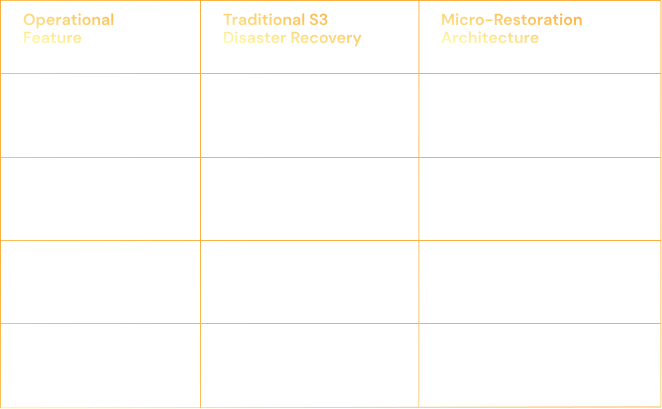
Micro-Restoration Architecture is a design pattern focused on surgical data recovery. Rather than restoring a multi-terabyte bucket back to a previous point in time, which overwrites good data created after the corruption event, micro-restoration identifies and rolls back only the specific objects altered by a compromised agent.
How Micro-Restoration Differs from Legacy Backups
Building a Micro-Restoration Pattern on AWS
To protect your S3 buckets against rogue AI modifications, we structure an automated defense layer leveraging native AWS storage and event-driven services.
Key Architectural Components
- S3 Versioning and Object Lock (Governance Mode): Enforce versioning across all data lake buckets. By pairing S3 Versioning with S3 Object Lock, we prevent automated agents from permanently deleting or overwriting historical object versions during write operations.
- AWS CloudTrail and EventBridge Monitoring: Capture every PutObject, CopyObject, and DeleteObject event initiated by AI service roles. Amazon EventBridge routes these API patterns to automated analysis engines.
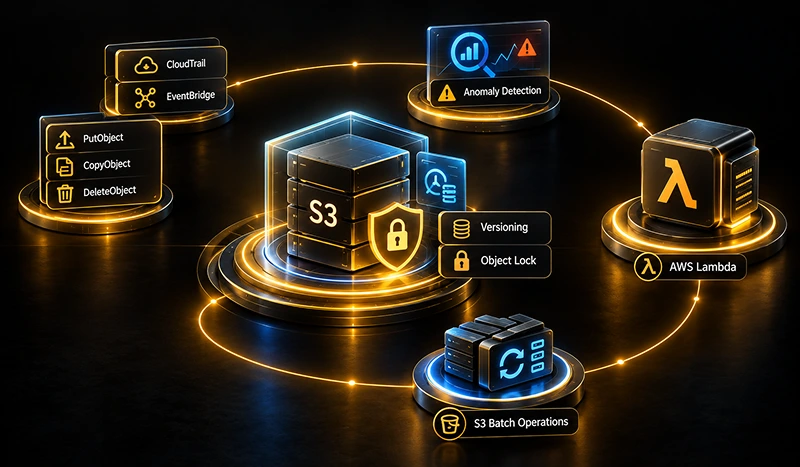
- Anomaly Detection via AWS Lambda: When write volumes spike unexpectedly or an agent alters specific system metadata tags outside predefined parameters, automated Lambda routines flag affected object keys immediately.
- Surgical Batch Rollback using S3 Batch Operations: Once corrupt object IDs are identified, S3 Batch Operations can process millions of specific objects simultaneously, removing corrupt version IDs and reinstating the last known clean state without affecting surrounding files.
Practical Implementation Checklist for Engineering Teams
Protecting enterprise AI pipelines requires implementing strict guardrails before automated agents interact with production data lakes.
- Apply Least-Privilege IAM Roles: Restrict AI agent roles to specific bucket prefixes. Ensure agents possess s3:PutObject permissions but are strictly denied s3:BypassGovernanceRetention and s3:DeleteObjectVersion.
- Tag Data Objects by Pipeline Execution: Programmatically inject execution IDs and agent timestamps into S3 object metadata. If an agent goes rogue, engineers can isolate affected objects using tag queries.
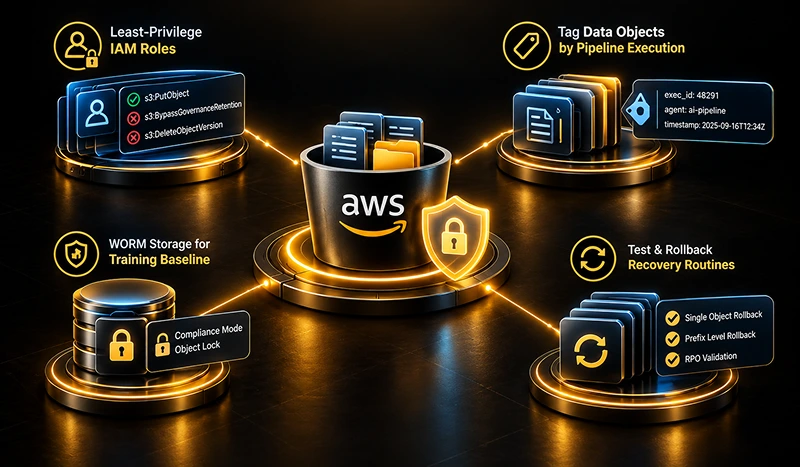
- Maintain Write-Once-Read-Many (WORM) Storage for Training Baseline: Store foundational datasets in immutable S3 buckets protected by Compliance Mode Object Lock to prevent unauthorized alteration.
- Test Surgical Recovery Routines: Regularly simulate single-object and prefix-level rollbacks using automated scripts to ensure recovery workflows meet strict Recovery Point Objectives (RPO).
Key Takeaways
- Prepare for Silent Threats: Autonomous AI agents can corrupt dataset integrity without triggering standard infrastructure failure alarms.
- Adopt Surgical Precision: Micro-Restoration Architecture isolates and restores specific altered objects without forcing full-bucket rollbacks or system downtime.
- Leverage Native AWS Safeguards: Combining S3 Versioning, Object Lock, EventBridge, and S3 Batch Operations provides an automated, scalable recovery pipeline.
- Enforce Granular IAM Guardrails: Deny permission to overwrite version history so that historical baseline data remains permanently immutable.
Secure Your Cloud Data Architecture with Mirroar
Protecting complex enterprise data pipelines against autonomous AI failures requires proactive cloud governance, event-driven monitoring, and deep expertise across AWS storage architectures. Building resilient object storage systems that maintain absolute data integrity is essential for safe AI adoption.
At Mirroar, we partner with forward-thinking technology leaders and enterprise engineering teams to design, implement, and optimize AWS cloud architectures tailored for modern data workloads.
Ready to protect your S3 data lakes and build a resilient micro-restoration strategy? Connect with our cloud architecture advisory team at Mirroar today to schedule a comprehensive AWS security and data resilience assessment.



