

Contrary to popular belief, Lorem Ipsum is not simply random text. It has roots in a piece of classical Latin literature from 45 BC, making it over 2000 years old.

Global enterprise spending on artificial intelligence continues to accelerate, yet a stark operational contradiction has emerged: enterprise AI maturity declined 20% year over year. Despite massive capital allocations toward algorithmic tools, customer satisfaction metrics remain stagnant, customer churn is rising, and frontline support teams face unprecedented operational strain.
This friction does not stem from a flaw in underlying AI models, but from a persistent strategic miscalculation. Enterprises are aggressively purchasing AI tools as isolated point products rather than investing in systemic business transformation. Infusing artificial intelligence into fragmented, siloed processes fails to create superior customer experiences; it simply scales operational inefficiency at a faster velocity.
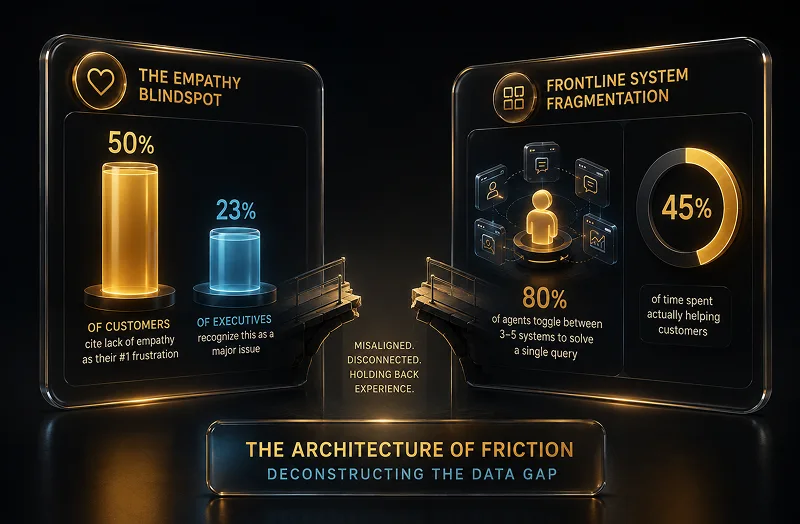
Insights from The CX Shift: A study of customer expectations in the AI era—which surveyed over 34,000 global executives, service professionals, and customers—surface a severe architectural and empathetic misalignment within modern customer relationship strategies.
The Empathy Blindspot
A profound disconnect exists between corporate perception and consumer reality regarding the quality of automated engagements:
This statistical variance highlights a listening problem rather than a data shortage. While leadership focuses on technical deployment milestones, the consumer experiences a cold, highly transactional interaction framework.
Frontline System Fragmentation
The administrative burden placed on human agents directly undermines their capacity to deliver high-touch service. The modern service representative's desk is a collection of legacy barriers.
Because 80% of service representatives must toggle between three to five completely separate software systems just to resolve a single customer query, their active engagement capacity is cut in half. Frontline agents spend only 45% of their working time actually helping customers. The remaining 55% is entirely consumed by system navigation, manual context hunting, and stitching together broken, siloed workflows.
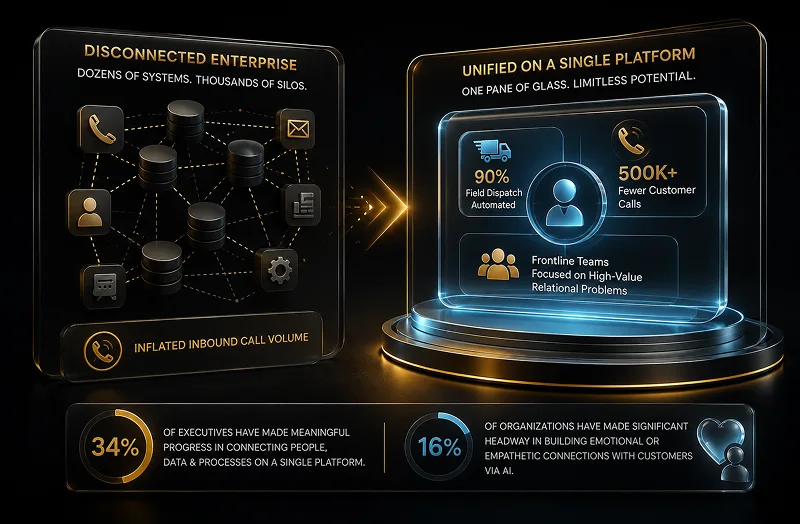
The systemic failure to unify data and operational layers prevents AI from achieving its architectural potential. According to the research, only 34% of executives state that their enterprises have achieved meaningful progress in connecting people, data, and processes on a single unified platform.
In contrast, a standard disconnected enterprise infrastructure spreads its footprint across dozens of systems and thousands of data silos, leading to severe inflation in inbound call volume. When these environments are successfully unified onto a single pane of glass, organizations realize massive operational returns, such as automating 90% of field dispatch logistics, processing half a million fewer customer calls, and freeing frontline teams to solve complex, high-value relational problems instead of hopping between systems.
Consequently, just 16% of organizations report significant headway in forging emotional or empathetic connections with customers via AI. Most legacy Customer Relationship Management (CRM) tools operate strictly as passive systems of record—static data repositories that store historical interactions but lack the real-time connective tissue to drive end-to-end autonomous automation.
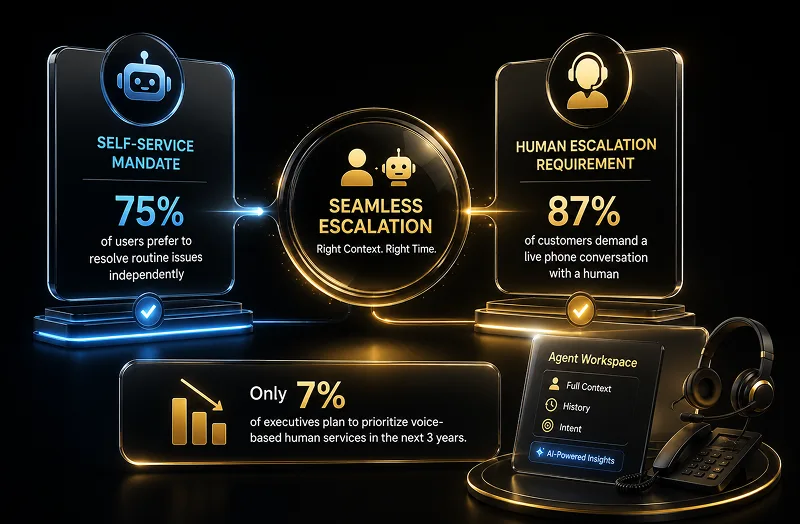
A modern customer experience strategy must respect consumer preference boundaries, which change dramatically based on the complexity of the underlying issue.
Despite this overwhelming consumer clarity, only 7% of executives plan to prioritize voice-based human services over the next three years. This mismatch cannot be bypassed with a basic chatbot. A truly seamless escalation path requires that when a human agent answers the phone, cross-enterprise AI has already surfaced the full situational context, history, and intent directly within their workspace—eliminating the need for the customer to repeat information.
The path toward superior customer experience is architectural, not incremental. True differentiation is realized when organizations stop treating AI as an isolated frontend feature and start establishing a unified platform core that synthesizes workflows across every department. Mirroar guides organizations through this architectural evolution—shifting success metrics away from simple automated deflection rates and anchoring them into definitive business growth, customer loyalty, and verified resolution outcomes.


