

Contrary to popular belief, Lorem Ipsum is not simply random text. It has roots in a piece of classical Latin literature from 45 BC, making it over 2000 years old.
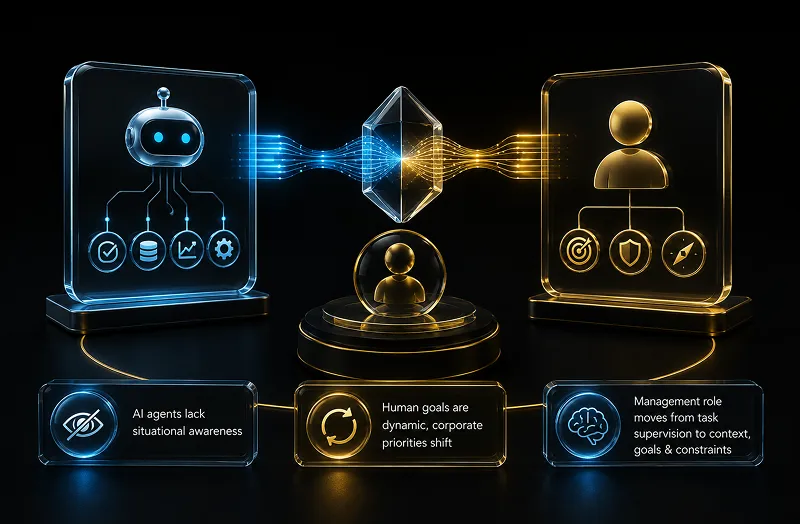
The rapid deployment of autonomous AI agents across enterprise operations introduces a fundamental question regarding structural oversight: if an artificial intelligence network can independently execute complex end-to-end workflows, what is the role of the human manager? Many organizations mistake autonomous execution for autonomous strategy, operating under the assumption that deploying intelligent agents eliminates the need for middle management.
In reality, agentic AI does not eliminate the necessity of management; it relocates it. While human workforces organically align through shared experiences, evolving office dynamics, and unspoken background context, an AI agent operates strictly on explicit instructions and historical dataset parameters. When a manager assigns an objective to an AI agent, the system treats it as a static task on a clean slate. It remains completely blind to surrounding strategic contexts—such as unannounced corporate transformations, fluid business priorities, or shifting macroeconomic conditions—that have not been explicitly codified into its permissions. This lack of situational awareness forces an architectural disconnect between managerial intent and autonomous machine action.
According to the ServiceNow Enterprise AI Maturity Index 2026, 51% of employees find it difficult to decipher how autonomous AI agents arrive at their operational decisions. Because human goals are dynamic and corporate priorities shift, AI agents lack the inherent organizational judgment to operate without structural human management. A high-performing agent might generate a logically flawless decision based on isolated data parameters that completely violates a broader, uncodified corporate strategy. This dynamic shifts the manager’s core responsibility from supervising routine human tasks to defining goals, constraints, and organizational context before an AI asset is ever deployed.
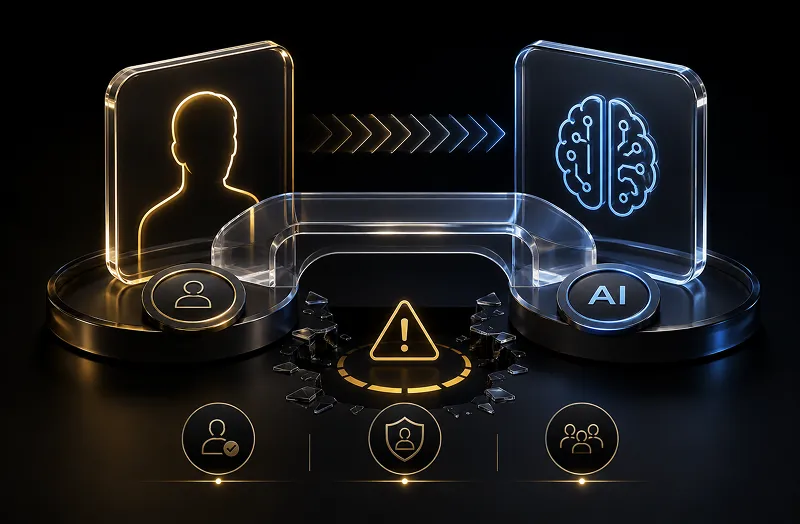
As autonomous systems assume a greater share of corporate decision-making, an insidiously disruptive psychological shift occurs within the workforce. Responsibility gradually and imperceptibly migrates from an active perspective ("I decided") to a passive justification ("The AI decided").
This accountability gap causes human employees to stop viewing themselves as the owners of an operational outcome, instead treating the system as an independent co-worker. Academic research from institutions such as MIT, Wharton, and NYU demonstrates that when individuals perceive an AI agent as the primary decision-maker rather than a processing input, they become significantly less likely to scrutinize its outputs, double-check automated data dependencies, or flag biased or anomalous recommendations. MIT research involving over 2,000 global leaders across 21 industries revealed that a primary roadblock in advanced AI adoption is not technical integration, but rather identifying what processes can be safely automated versus what tasks require an absolute human owner.
This structural tension is further validated by the ServiceNow Enterprise AI Maturity Index 2026, which notes that 53% of employees harbor concerns that the proliferation of autonomous AI agents is causing them to lose control over their operational decisions. This is primarily an architectural design failure, indicating that explicit human accountability boundaries were not systematically engineered into the workflow prior to deployment.
The urgent need for continuous, automated governance frameworks becomes starkly apparent when evaluating human behavior during high-stress operational scenarios. When workloads spike and time pressures mount, human personnel consistently default to AI recommendations without applying critical oversight or qualitative skepticism.
Controlled laboratory experiments conducted by New York University and the University of Michigan revealed that algorithm reliance spikes from 39% to 48% under high-pressure conditions. This behavioral shift is driven entirely by a need for execution velocity rather than an increase in systemic trust. Ironically, the precise operational moments that demand the highest degree of human skepticism and nuanced judgment are exactly when employees are psychologically predisposed to accept automated advice without review. To prevent this default behavior from introducing catastrophic operational risks, managers must pre-define explicit automation conditions, guardrails, and human escalation protocols within a centralized governance system.
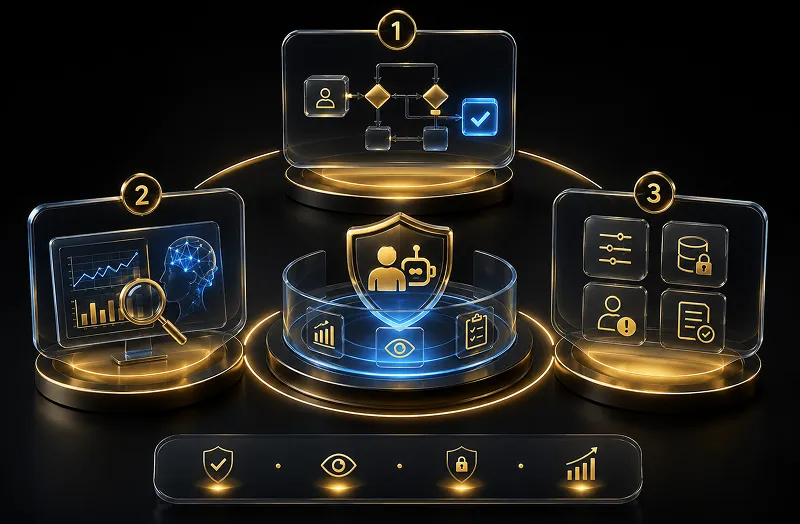
To establish a highly optimized, compliant, and productive division of labor between human teams and autonomous systems, organizations must implement three foundational governance methodologies.
Re-Architecting Cross-System Workflows
Placing an autonomous AI agent into an unstable or poorly defined corporate role introduces disproportionate risk. The downside of positioning an agent in an incompatible operational function significantly outweighs the upside of a correct placement. Managers must actively redesign corporate workflows to accommodate autonomous decision-making. This includes rewriting individual role descriptions, restructuring traditional decision tree models, and establishing explicit parameters for where an agent adds definitive value versus where it acts as an operational obstacle.
Enforcing Continuous Decision Logic Visibility
Accountability requires total structural transparency. Managers cannot manage, evaluate, or correct machine judgment that remains hidden inside a black-box model. Oversight must move away from a one-time configuration checkpoint and shift toward real-time visibility. Through centralized administrative dashboards, human owners must have constant access to an agent's underlying reasoning, weighting criteria, and source data. This allows an manager to review exactly how a system balanced variables like demand, margin, and competitive data before approving an output—treating the agent with the same continuous context-setting and checkpoint auditing applied to a junior employee.
Automating Oversight Prior to Deployment
If an enterprise chooses to automate its operational workflows, it must simultaneously automate its compliance and oversight frameworks. Relying on managers to manually track, read, and audit every individual agent interaction causes immediate operational bottlenecks, entirely erasing the efficiency gains realized by automation. Before an agent is introduced into production, management must hardcode four critical structural parameters:
By designing autonomous agents with the same structural rigor applied to hiring a human professional—equipping them with a clear job description, bounded permissions, explicit goals, and firm escalation paths—enterprises can convert unmanaged operational risks into highly controlled, productive assets.
True innovation is never achieved by completely removing human oversight from the operational loop. The value of autonomous AI agents is unlocked only when they are paired with rigorous, real-time human governance frameworks. By leveraging centralized platform architectures like the ServiceNow AI Control Tower, Mirroar enables enterprises to establish transparent systems of record that enforce accountability, maintain absolute visibility, and automate guardrails at the exact points where AI agents act. This ensures that as your autonomous workforce scales, your managers retain total strategic control over every decision executed across the enterprise.


