

Contrary to popular belief, Lorem Ipsum is not simply random text. It has roots in a piece of classical Latin literature from 45 BC, making it over 2000 years old.
Corporate leaders frequently approach employee burnout as a psychological or cultural issue to be solved through wellness benefits or vacation policies. However, a deeper evaluation of modern corporate infrastructure reveals a more tangible culprit: institutional technology friction. Modern professionals do not just suffer from heavy workloads; they are systematically drained by "toggle fatigue"—the exhausting requirement to constantly shift between a chaotic array of separate enterprise portals, disconnected tools, and fragmented communication channels just to complete routine tasks.
When organizations attempt to mitigate this strain by rapidly deploying standalone artificial intelligence tools, they often inadvertently worsen the problem. Introducing isolated conversational assistants or sidecar plugins onto a fractured tech stack creates a layer of cosmetic automation. Employees are forced to manage yet another application interface, copy and paste data between tools, and double-check unverified model outputs. Instead of alleviating burnout, layering AI onto broken, disconnected processes simply speeds up the accumulation of digital noise. True relief requires an architectural shift away from assistive add-ons and toward a single, unified experience platform designed to automate tasks completely on behalf of the workforce.
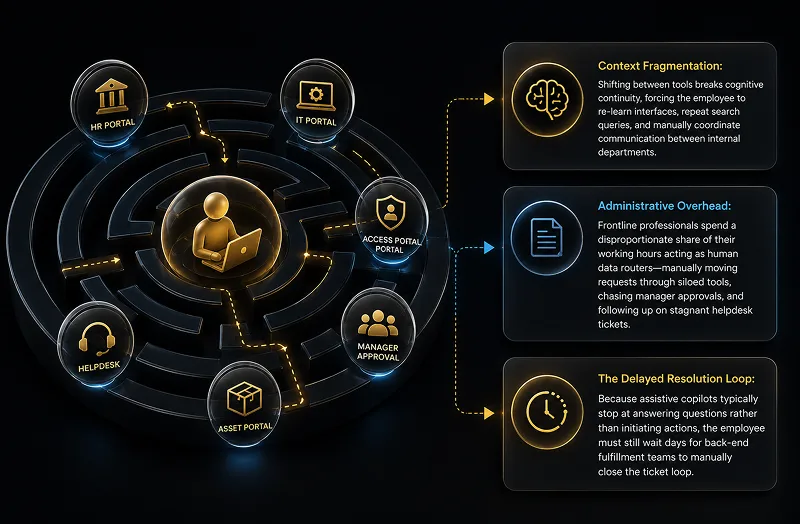
To understand why traditional AI implementations fail to reduce employee exhaustion, organizations must look closely at how daily work actually gets executed.
In a standard enterprise environment, an employee requiring routine support—such as updating direct deposit details, provisioning software access, or tracking an office hardware request—must navigate separate specialized portals. This siloed layout taxes both time and energy:
Alleviating burnout requires shifting the role of artificial intelligence from a passive conversational tool into an active digital worker. Through native platform integration that connects data, user interaction, and automated workflows, the system transitions from merely advising employees to executing complex multi-step tasks end-to-end.
Establishing a Single Conversational Interface
Instead of forcing the workforce to remember which specific back-end department handles a given request, the platform presents a single interface for all employee needs. Using natural language, individuals simply describe their intent—whether requesting a new laptop, modifying benefit selections, or reporting an access issue. The underlying system automatically interprets the intent, unifies cross-departmental data paths, and maps the request to the correct destination without the user ever leaving the primary workspace environment.
Closed-Loop Workflow Automation
True productivity gains are achieved when an automated system moves past basic text summaries and directly triggers back-end orchestration. When an employee submits a request through the interface, the platform connects directly to the enterprise workflow engine to manage the entire process autonomously: 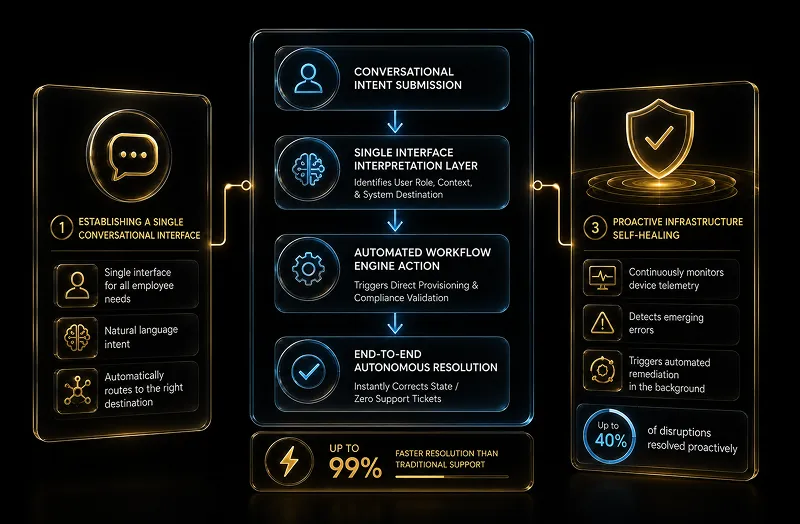
By linking conversational frontdoors with robust back-end fulfillment capabilities, the system completely bypasses manual data entry, removes human handoffs, and resolves cases up to 99% faster than traditional support methods.
Proactive Infrastructure Self-Healing
The most effective way to eliminate workplace frustration is to resolve infrastructure failures before the employee even encounters them. Through direct integrations with device telemetry and real-time intelligence networks, the platform continuously monitors hardware performance, detects emerging errors, and triggers automated remediation workflows in the background. Up to 40% of IT and system disruptions can be resolved proactively, cutting down support ticket volumes and ensuring workplace technology remains invisible, reliable, and functional.
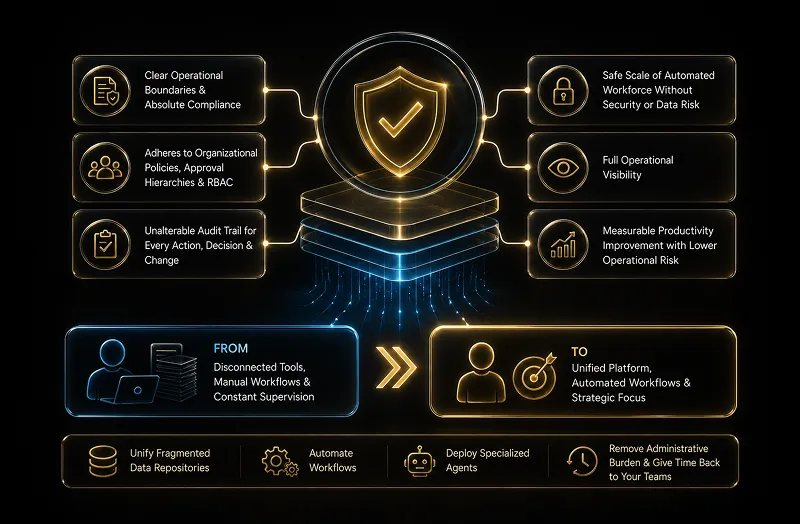
Entrusting autonomous workflows with cross-enterprise system access requires clear operational boundaries and absolute compliance. To scale an automated workforce safely without risking security breaches or data leaks, all machine execution is managed through the platform's native centralized control architecture.
This structural framework guarantees that every automated action adheres strictly to a company's specific organizational policies, predefined approval hierarchies, and role-based access controls. Every decision, data call, and system configuration change leaves an unalterable audit trail, providing full operational visibility. By automating both the daily workload and the compliance frameworks that govern it, enterprises achieve measurable productivity improvements while lowering operational risk.
Employee burnout cannot be managed out of existence using disconnected, superficial technology add-ons that demand constant human supervision. True operational resilience is unlocked when an organization addresses the underlying architectural friction that causes fatigue in the first place. By unifying fragmented data repositories, automating workflows, and deploying specialized agents within a single platform structure, enterprise leaders can permanently remove administrative burdens. Mirroar aligns this technology architecture to transform daily operations, giving time back to your teams so they can focus on high-value, strategic outcomes.


