How Yahoo Enhances Search Retargeting Using Amazon Bedrock: A Modern AdTech Framework
In digital advertising, capturing user intent at the precise moment of search is the holy grail of conversion optimization. Traditional search retargeting has long relied on matching rigid keywords and static query parameters. However, consumer search behavior is rarely linear; users express intent using complex natural language, subtle context clues, and shifting semantics that simple keyword lookup tables often misread. Modern ad platforms require intelligent, context-aware systems capable of decoding intent instantaneously.
This case study examines how Yahoo enhances search retargeting using Amazon Bedrock, transforming vast streams of search telemetry into highly relevant, targeted ad experiences. By adopting generative foundation models within a managed cloud ecosystem, enterprise platforms can interpret intent beyond exact keyword matches, streamline ad-copy alignment, and process campaign updates at scale. Below, we break down the underlying architecture, strategic advantages, and key implementation principles driving this AdTech modernization.
Beyond Keyword Matching: Decoupling Intent from Literal Search Strings
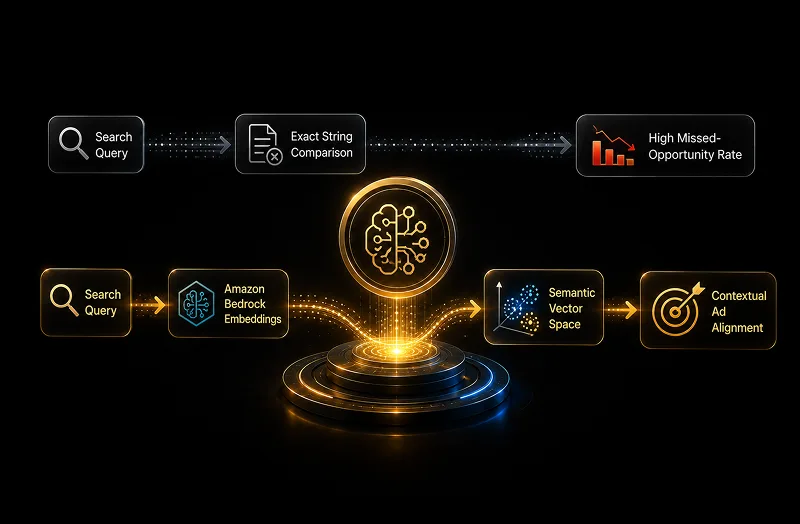
Traditional retargeting mechanisms evaluate search queries by comparing incoming strings against predetermined lists of advertiser keywords. While effective for direct product searches, this approach introduces two major operational bottlenecks:
- Low Semantic Comprehension: A user searching for "best eco-friendly sneakers for trail running" might miss targeted ads configured strictly for "sustainable running shoes" if exact keyword overlaps are missing.
- Manual Taxonomy Overhead: Ad operations teams spend hundreds of hours manually mapping related search terms, misspellings, and long-tail variants to broad campaign buckets.
Unlocking Semantic Intelligence
To overcome these barriers, modern retargeting pipelines shift from literal string matching to
semantic vector analysis. By embedding search queries into high-dimensional vector spaces using foundation models on Amazon Bedrock, platforms can evaluate the conceptual meaning of a user’s search. This enables systems to recognize that distinct phrasing such as "budget-friendly home gym setup" and "affordable workout gear at home" reflects identical purchasing intent.
Architectural Framework: Integrating Amazon Bedrock into AdTech Pipelines
Retargeting systems operating at web scale process billions of ad requests daily. Incorporating generative AI requires an architecture designed for ultra-low latency, robust data isolation, and high availability.
Managed Foundation Models with AWS Enterprise Guardrai
By using Amazon Bedrock, ad platforms gain access to leading foundation models without the operational burden of managing underlying compute clusters or model weights. This managed serverless approach ensures that prompt interactions, semantic embeddings, and inferencing operations scale dynamically alongside real-time search traffic surges.
Privacy-First Data Isolation
AdTech enterprises process proprietary user engagement metrics and advertiser data under strict privacy regulations. Amazon Bedrock ensures that customer telemetry and search interactions remain strictly within an organization’s virtual private cloud (VPC). User data is never used to train base foundation models, safeguarding brand integrity and regulatory compliance.
Realizing Business Value: Higher Relevance, Lower Operational Friction
Enhancing retargeting engines with foundation models generates measurable impact across advertiser campaign performance and platform efficiency.
Precision Audience Segmentation
By evaluating search intent through context-aware models, platforms construct richer user profiles. Advertisers can serve highly tailored ad copy that directly addresses the nuance of a user's recent search, increasing click-through rates (CTR) and optimizing advertising spend return.
Automated Campaign Asset Generation
Beyond audience targeting, foundation models help streamline campaign creation for advertisers. Managed AI workflows can analyze a advertiser's target parameters and automatically suggest optimized ad copy variants, headline options, and contextual keyword expansion lists in seconds.
- External Linking Opportunity: Explore digital advertising metrics and privacy standards established by the [Interactive Advertising Bureau (IAB) Modern AdTech Standards].
Key Takeaways
- Semantic Intent Trumps Exact Keywords: Modern search retargeting leverages foundation models to decode the true contextual meaning of user queries rather than relying on rigid keyword lists.
- Serverless Infrastructure Delivers Scale: Managed foundation models on Amazon Bedrock allow ad platforms to process massive search telemetry volumes without maintaining complex ML infrastructure.
- Privacy Is Built-In: Enterprise-grade VPC isolation guarantees that proprietary advertising data and search telemetry remain fully protected and are never exposed to public training sets.
- Operational Automation Reduces Friction: Generative tools streamline advertiser workflows by automatically expanding target themes and generating contextually aligned campaign assets.
Elevate Your Enterprise AdTech Stack
Examining how Yahoo enhances search retargeting using Amazon Bedrock demonstrates the transformative power of generative AI when applied to real-time intent processing. By combining semantic context with serverless infrastructure, digital platforms can unlock unprecedented advertising relevance while reducing operational overhead.
Ready to modernize your search and targeting infrastructure? Connect with our team of AWS solutions architects today to design secure, high-throughput AI pipelines for your business.